TL;DR: Warm air from the vents usually means a dirty condenser coil, a low refrigerant charge, or a failed capacitor, not always a dying system. Cooling repair in Chino typically runs $150 to $650 for common fixes like capacitors, contactors, or a refrigerant top-off, and $1,200 or more for a compressor. If the system is past 12 years old and the repair quote runs near half the cost of a new unit, replacement usually wins on total cost of ownership.
If your AC has been running nonstop through the afternoon near Ayala Park or out toward the Chino Airport corridor and the house still isn’t cooling below 78, you’re dealing with one of a handful of usual suspects. September afternoons in Chino still push into the 90s, and an overworked system that limped through July often finally gives out once the compressor has logged a few thousand extra run hours. Here’s how to figure out what’s actually wrong before you spend money on the wrong fix.
Why Is My AC Running But My House Isn’t Cooling?
An AC that runs constantly without cooling the house is almost always losing heat transfer somewhere in the refrigerant cycle, most commonly a dirty outdoor condenser coil, a low refrigerant charge from a slow leak, or a failing capacitor that’s making the compressor labor.
A condenser coil caked with dust, cottonwood fluff, or dryer lint can’t reject heat properly, so the system runs longer to hit the same setpoint and never quite gets there. This is common in Chino’s older ranch-style neighborhoods where condensers sit close to block walls with limited airflow clearance. A quick rinse with a garden hose (power off) sometimes buys a homeowner a few degrees, but it won’t fix a coil that’s been neglected for years.
Low refrigerant is a different problem entirely. Refrigerant doesn’t get “used up” the way gasoline does. If the charge is low, the system has a leak, usually at a Schrader valve, a brazed joint, or a coil pinhole. Refrigerant work is regulated under the Clean Air Act, and recovery or recharge must be performed by a technician holding an EPA Section 608 certification. A tech topping off refrigerant without finding and sealing the leak first is treating a symptom, not the problem, and you’ll be paying for another top-off within a year.
What Does AC Repair Cost in Chino, CA?
Most single-component AC repairs in the Inland Empire run between $150 and $650, with capacitors and contactors at the low end and compressor or evaporator coil failures pushing well past $1,200.
Here’s roughly how the common failures break down:
- Capacitor replacement: $150-$350. The capacitor stores the electrical charge that kicks the compressor and fan motor into motion. A swollen or bulging capacitor is a near-certain sign it’s failed.
- Contactor replacement: $150-$300. Pitted contactor points can cause a system to hum without starting, or to run the fan without the compressor engaging.
- Refrigerant leak repair plus recharge: $450-$1,200, depending on whether the leak is at an accessible fitting or inside the coil itself. A leak search using an electronic sniffer or UV dye adds diagnostic time but prevents repeat visits.
- Compressor replacement: $1,200-$2,800 installed, sometimes covered partially under a manufacturer parts warranty if the unit is inside its warranty window (typically 5-10 years, but labor is rarely included).
- Blower motor or fan motor: $350-$700.
Any written quote should specify the exact part, the refrigerant type (most Chino-area systems installed before 2010 still run R-22, which is no longer produced under EPA phase-out rules, making leak repairs on those systems significantly pricier than on R-410A units), and whether the diagnostic fee rolls into the repair cost if you move forward.
What Are the Warning Signs You Need Cooling Repair Now?
Short cycling, warm air at the registers, ice on the indoor coil or refrigerant lines, and a spike in your SCE bill without a spike in usage are the four signs that mean call now instead of waiting.
Short cycling, where the compressor kicks on and off in under 10 minutes repeatedly, strains the compressor and usually points to either a refrigerant issue or an oversized unit that was never matched to the home’s actual load in the first place (a common mistake on 1980s and 1990s Chino tract homes that got a straight equipment swap instead of a proper ACCA Manual J load calculation).
Ice forming on the indoor coil or the copper suction line means airflow or refrigerant is restricted somewhere upstream, often a filthy air filter or a coil that’s iced over from a slow leak. Running the system with visible ice will eventually flood the compressor with liquid refrigerant, which is a much more expensive failure than the original problem. Shut the system off, run the fan alone to thaw the coil, and get it looked at before running it again.
A utility bill that climbs 20-30% month over month with no change in habits usually means the system is working much harder to deliver the same cooling, a classic sign of a coil losing efficiency or a duct leak dumping cooled air into an attic or crawlspace before it reaches the living space. If your ductwork hasn’t been inspected in a while, duct cleaning and sealing is worth ruling out alongside the AC itself.
Should You Repair or Replace an Aging AC System?
The rule of thumb: if the repair estimate is more than 50% of the cost of a new comparable system, and the unit is past 10-12 years old, replacement is usually the better financial call.
We’ve written about this same math for furnaces in Furnace Repair or Replace? The 50% Rule and Other Ways To Decide, and the logic transfers directly to cooling equipment. A 12-year-old condenser with a failed compressor is a system where every remaining major component (the coil, the blower motor, the control board) is also 12 years closer to failure. Spending $1,800 on a compressor replacement to keep a SEER 10 or SEER 13 unit alive rarely pencils out against a new SEER2-rated system that will run cheaper every single month it operates.
Current federal minimum efficiency standards require SEER2 13.4 or higher for split systems in the Southwest region, and many manufacturers now offer 16-18 SEER2 equipment where the ENERGY STAR efficiency gains show up directly on the utility bill within a few summers. If your system is under 8 years old, a straightforward repair almost always makes more sense than starting over.
Either way, get the diagnosis in writing before you decide anything. A legitimate quote lists the failed component, the measured refrigerant pressures or amp draw that led to that diagnosis, and the price broken out for parts versus labor. If a tech can’t explain why a part failed, get a second read before authorizing the fix.
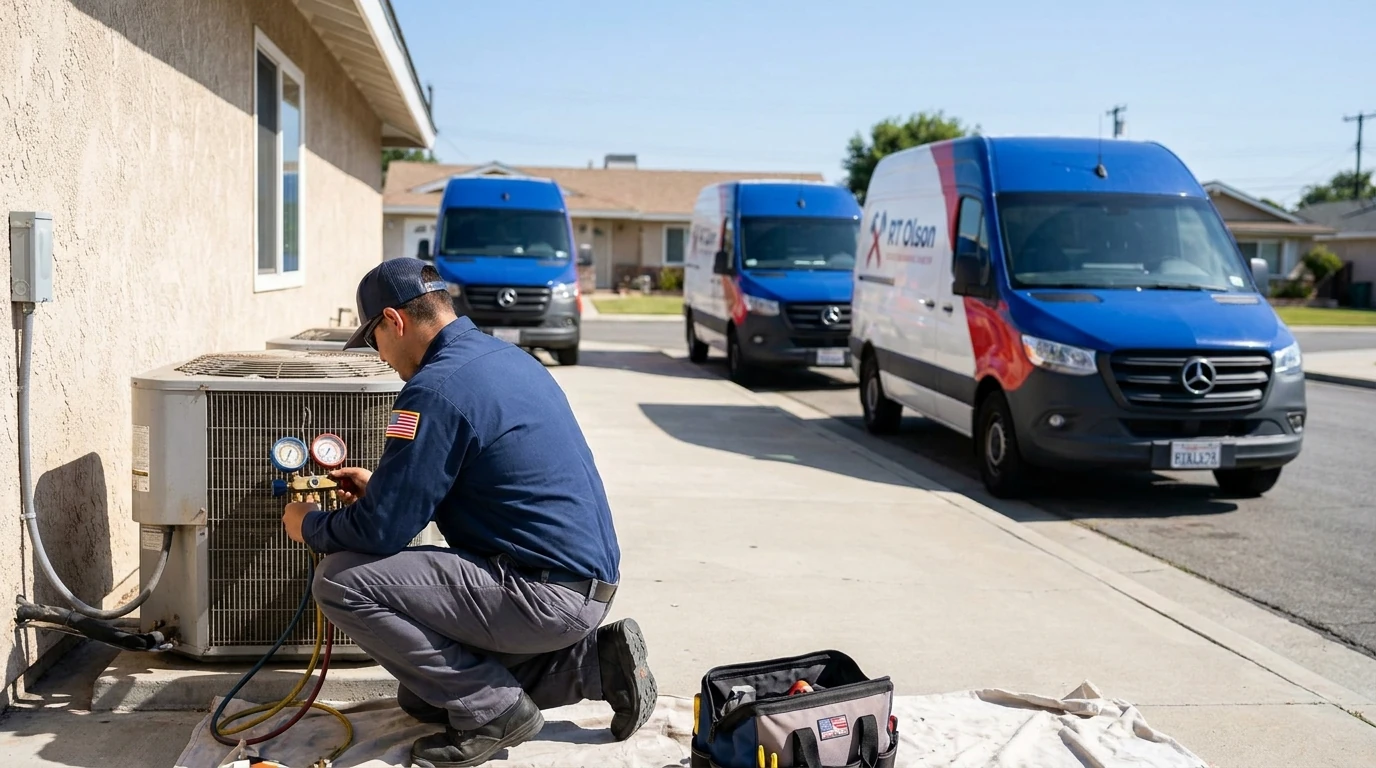
If your system in Chino is short cycling, icing up, or just not keeping the house cool through these last warm weeks of the season, a proper diagnostic visit settles the question in under an hour. RT Olson Plumbing, Heating and Air Conditioning schedules cooling repair calls across Chino and the surrounding Inland Empire, and every quote includes the measured readings behind the recommendation.
About RT Olson Plumbing, Heating and Air Conditioning
RT Olson Plumbing, Heating and Air Conditioning is a locally owned and operated, licensed and insured contractor (license 997337) based in Corona, CA, serving Chino and the greater Inland Empire since 2014. Their technicians handle plumbing, drains, water heaters, and heating and air conditioning repair and installation, with 24/7 emergency service available.