Air Conditioning Repair in Corona
Trusted air conditioning repair in Corona and surrounding areas. Licensed and insured plumbing and HVAC pros, upfront pricing, free estimates. Call (951) 344-5596.
Your AC ran fine last summer. Now it’s blowing warm air, cycling on and off every few minutes, or not turning on at all, and the temperature inside is already climbing past 85°F. In the Inland Empire, that’s not a minor inconvenience; it’s a health concern, especially during July and August when Corona regularly sees triple-digit heat. The difference between a fast, accurate diagnosis and a slow or misdiagnosed repair can mean days of lost comfort and a repair bill that spirals when the wrong part gets replaced first.
What air conditioning repair actually involves
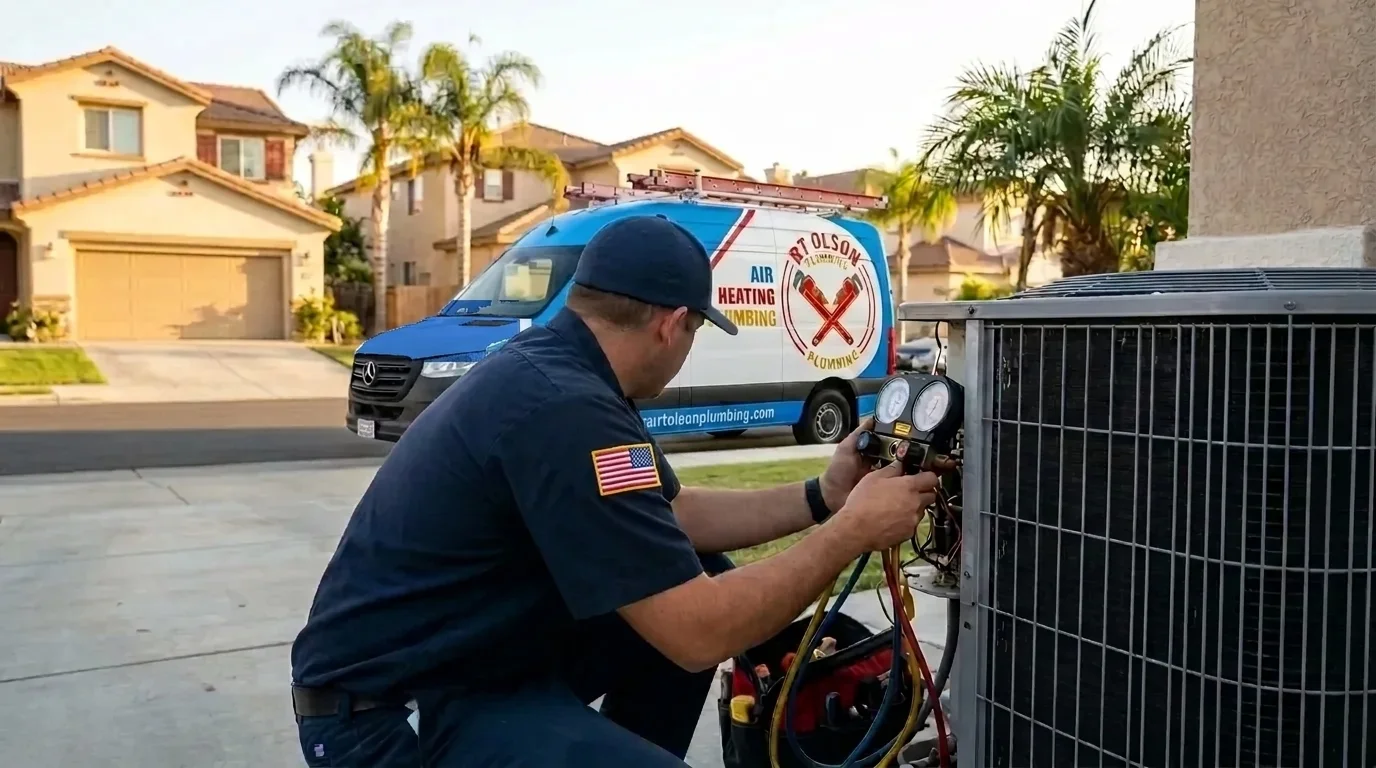
Central air repair is a diagnostic process before it’s ever a parts-and-labor job. A technician who skips the diagnostic phase and jumps straight to replacing a capacitor or recharging refrigerant is guessing, and guessing costs homeowners money. A proper repair visit starts with measuring system performance: supply and return air temperatures, static pressure across the air handler, refrigerant pressures on both the high and low sides, and electrical readings at the disconnect, contactor, and capacitor. Those numbers tell the story. A low delta-T (the difference between supply and return air temperature) points toward refrigerant issues or a dirty evaporator coil. High head pressure with normal suction pressure often signals a condenser problem, dirty coils, a failing fan motor, or restricted airflow. Electrical faults show up in amp draws and voltage readings before a component fails entirely.
Common repair categories include refrigerant leak detection and recharge, capacitor and contactor replacement, condenser and evaporator coil cleaning, blower motor and fan blade repair, thermostat and control board diagnostics, and condensate drain clearing. Most straightforward repairs are completed in a single visit. Refrigerant leak repair, finding the leak, sealing or replacing the affected component, pressure-testing, and recharging, typically takes two to four hours depending on where the leak is located.
Our process
-
System performance baseline. Before touching anything, we measure supply air temperature, return air temperature, and system pressures. This gives us a before-and-after benchmark and prevents unnecessary part replacement.
-
Refrigerant circuit inspection. We check high-side and low-side pressures against the manufacturer’s specifications for the refrigerant type in your system (R-22 or R-410A). If pressures are off, we use an electronic leak detector to locate the source, not just add refrigerant and send you a bill.
-
Electrical component testing. Capacitors, contactors, and control boards are tested under load, not just visually inspected. A capacitor can read within spec on a multimeter and still fail when the compressor tries to start on a 105°F afternoon.
-
Coil and airflow assessment. A dirty evaporator coil or a clogged condensate drain can mimic refrigerant undercharge on a pressure gauge. We inspect both before drawing conclusions about the refrigerant circuit.
-
Repair, retest, and document. After the repair, we re-measure system performance to confirm the fix held. We document refrigerant type, quantity added, and all replaced components, information you’ll need if the system is under a manufacturer’s or home warranty.
What separates a good AC repair from a bad one
The most common mistake in residential AC repair is treating low refrigerant as a maintenance item rather than a symptom. R-410A and R-22 systems are closed loops, refrigerant doesn’t deplete on its own. If a system is low, there is a leak somewhere. Adding refrigerant without finding and fixing the leak means the system will be undercharged again within months, and the repeated thermal stress on a compressor running low on refrigerant shortens its life significantly.
A second common failure point is misdiagnosing an electrical problem as a refrigerant problem. When a dual-run capacitor is weak, the compressor struggles to start and may short-cycle or trip the breaker, symptoms that look like a refrigerant issue to an untrained eye. Electrical testing with a true RMS multimeter and a clamp meter catches this before an unnecessary refrigerant service call.
For systems still running R-22 (common in Corona homes built before 2010), parts availability and refrigerant cost are real factors. A technician should be honest about the repair-versus-replace calculus on an aging R-22 system rather than performing a costly repair on equipment that’s nearing the end of its serviceable life.
Seasonal and regional considerations
Corona’s climate means air conditioners run hard from May through October, and the Santa Ana wind events that push through the Inland Empire in fall and spring carry fine particulate that clogs condenser coils faster than in coastal climates. Systems that haven’t had coils cleaned in two or more seasons often show their worst performance exactly when demand peaks, late June through August. Scheduling a diagnostic early in the cooling season, before the first heat wave, avoids the longest wait times and catches refrigerant or electrical issues before they become emergency calls on a 108°F afternoon.
Service area
RT Olson Plumbing, Heating and Air Conditioning is based in Corona and serves surrounding communities throughout the Inland Empire and western Riverside County, including Norco, Eastvale, Chino Hills, Riverside, Jurupa Valley, and Mira Loma. City-specific service pages are linked throughout the site for homeowners searching locally.
If your AC is blowing warm air, short-cycling, or simply won’t turn on, call (951) 344-5636 to schedule a diagnostic. We’re available around the clock, license #997337.
Services We Handle
- AC Maintenance
- Air Conditioner Repair
- HVAC System Repair
- Repair HVAC
- Repair Thermostat
Frequently Asked Questions
My AC is running but not cooling the house — what's most likely wrong?
Does homeowners insurance cover air conditioning repair?
How do I know if my AC needs refrigerant or just a cleaning?
My system is still running R-22. Is it worth repairing?
What should I do while waiting for an AC repair technician to arrive?
Looking for the best air conditioning repair company in Corona?
RT Olson Plumbing, Heating and Air Conditioning provides licensed and insured air conditioning repair in Corona, CA and the surrounding area, and has served local property owners since 2014. Customers rate us 4.9 out of 5 stars across 619 Google reviews. We answer calls 24/7 — call (951) 344-5596 for immediate help.
Need Air Conditioning Repair now?
We respond 24/7 across Corona and surrounding CA cities.
Related Coverage
- Our Plumbing Services, Plus Heating & Air
- Contact RT Olson Plumbing, Heating and Air Conditioning
- Air Conditioning Repair in Anaheim
- Air Conditioning Repair in Chino
- Air Conditioning Repair in Fullerton
- Air Conditioning Repair in Norco
- Air Conditioning Repair in Ontario
- Air Conditioning Repair in Riverside
- Air Conditioning Repair in Santa Ana
- Air Conditioning Repair in Yorba Linda
- Cooling Repair in Chino, CA: What's Actually Wrong and What It Costs to Fix