
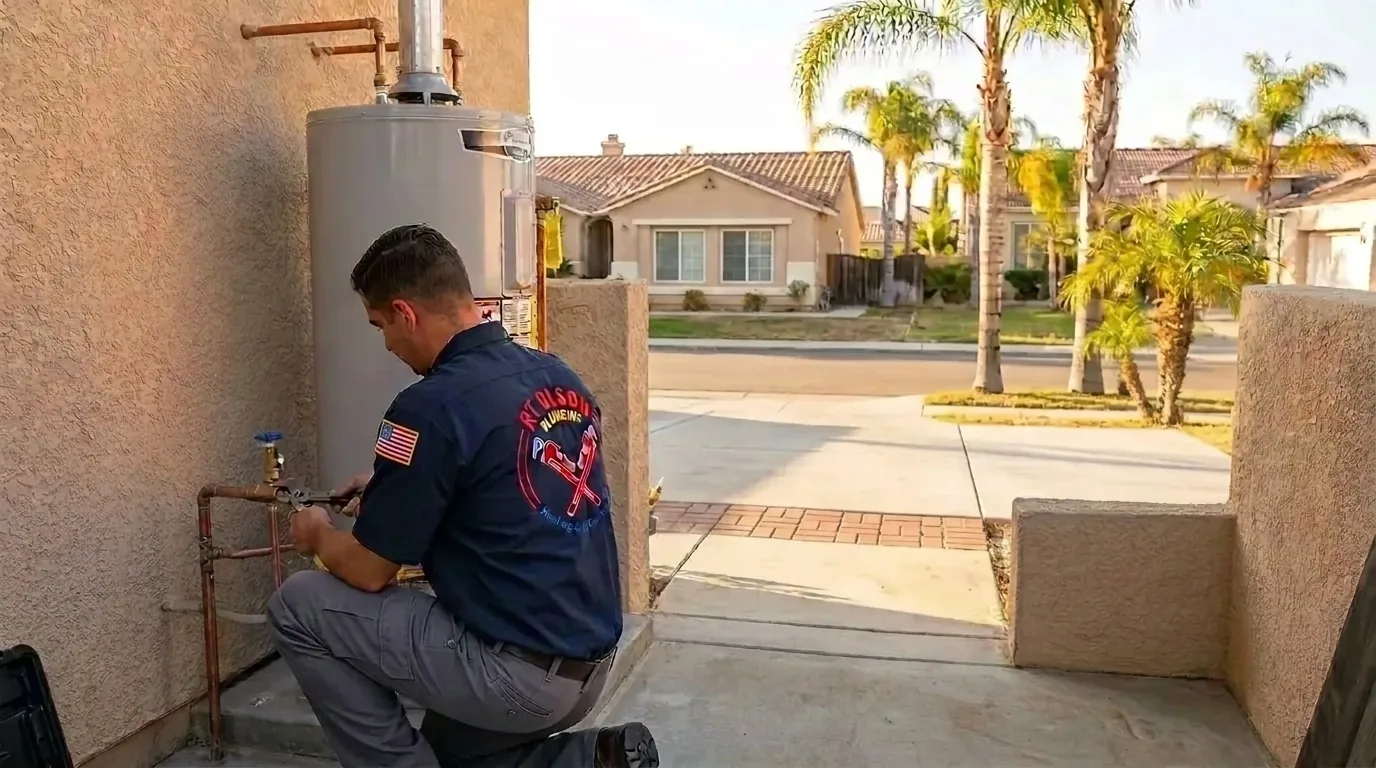
Water Heater Installation and Replacement in Corona
Trusted water heater installation and replacement in Corona and surrounding areas. Licensed and insured plumbing and HVAC pros, upfront pricing, free estimates. Call (951) 344-5596.
When a water heater fails, it rarely gives much warning. One morning the shower runs cold after two minutes; a week later there’s a rust-colored stain on the garage floor and a puddle spreading toward the drywall. Whether you’re dealing with a tank that’s past its service life, a unit that never kept up with your household’s demand, or a first-time tankless water heater installation, getting the right equipment sized and installed correctly determines how long the replacement actually lasts, and whether you’ll be doing this again in five years.
What water heater installation and replacement actually involves
Replacing a water heater is more than a swap. The existing unit has to be safely disconnected from gas or electrical supply, the water lines shut off and drained, and the old tank removed, which, at 150 pounds or more when full, is a two-person job in a tight garage or closet. Once the space is clear, the new unit has to be set, connected to supply and discharge lines, fitted with a new temperature-and-pressure relief valve (required by code on every installation), and tested under pressure before the water is turned back on.
For tankless water heater installations, the scope expands. A tankless unit fires a high-BTU burner on demand, which often requires a dedicated gas line upgrade from ½-inch to ¾-inch or larger, a new flue configuration, and, for whole-house electric tankless units, a significant electrical service upgrade. Venting for a condensing tankless unit also differs from a conventional flue, so existing vent runs frequently can’t be reused.
Tank sizing matters more than most homeowners realize. A 50-gallon water heater install is the standard recommendation for households of three to five people, but first-hour rating, how much hot water the unit can deliver in the first hour of heavy use, is the number that actually predicts performance. A high-efficiency 40-gallon unit with a strong first-hour rating can outperform a standard 50-gallon tank in a busy household.
Most installations in a straightforward swap scenario take two to four hours. Tankless conversions or jobs that require gas line or electrical work run longer.
Our process
-
Site assessment and sizing, Before any equipment is ordered, we confirm the existing fuel type, available gas pressure or electrical capacity, flue configuration, and space constraints. We also ask about household size and usage patterns so the replacement unit is sized to actual demand, not just matched to whatever was there before.
-
Equipment selection and permit pull, In Corona and throughout Riverside County, water heater replacements require a permit. We pull the permit, schedule the inspection, and help you choose between tank and tankless options based on your budget, usage, and whether your gas or electrical infrastructure can support a tankless unit without a costly upgrade.
-
Safe removal of the existing unit, We shut off gas or power, close the water supply, attach a hose to drain the tank, and disconnect the flue or electrical connections. The old unit is hauled off, you don’t have to figure out how to dispose of a 40- or 50-gallon tank.
-
Installation, connection, and code compliance, The new unit is set, all connections are made to current California plumbing code, a new T&P relief valve and discharge line are installed, and the unit is lit or energized. We check for gas leaks at every joint before leaving the site.
-
Test, inspect, and walk-through, We run the unit through a full heat cycle, confirm the thermostat setting (120°F is the standard safe setting), and walk you through the maintenance steps, anode rod service intervals, flushing schedules for tankless units, that extend the life of the equipment.
What separates a good installation from a bad one
The most common mistake on a water heater replacement is skipping the permit. In Riverside County, an unpermitted water heater installation can create problems at resale and may void the manufacturer’s warranty. A permitted job includes a city inspection that confirms the T&P valve, seismic strapping, and flue are all correct, details that matter if the unit ever fails and a homeowner files an insurance claim.
On tankless installations, undersizing the gas supply line is the most frequent technical error. A tankless unit drawing 199,000 BTUs on a ½-inch gas line will never reach full output, and the unit will fault under heavy demand. Proper gas pressure testing before and after the line upgrade is the only way to confirm the installation will perform as rated.
For electric water heaters, failing to verify that the panel has capacity for the new load, especially on older Corona homes with 100-amp service, can result in tripped breakers or, worse, an overloaded circuit. We check panel capacity before recommending an electric unit.
Anode rod condition is another detail that separates a thorough job from a rushed one. On a tank-to-tank swap, inspecting and replacing the anode rod at installation adds years to the new tank’s life and costs very little relative to a premature tank failure.
Seasonal and regional considerations
Southern California’s hard water is one of the biggest factors shortening water heater life in the Inland Empire. Corona’s municipal water supply, sourced through the Metropolitan Water District, carries dissolved minerals that accelerate sediment buildup inside tank-style heaters. That sediment layer acts as insulation between the burner and the water, forcing the unit to run longer and hotter to reach temperature, which stresses the tank lining and shortens the anode rod’s effective life. Annual flushing slows this process; a whole-home water softener or a scale-inhibiting filter on a tankless unit can extend equipment life significantly.
Summer heat also affects water heater performance. When incoming cold water temperatures rise in July and August, tankless units have a shorter temperature rise to achieve, which is actually an efficiency advantage. In winter, incoming water is cooler and tankless units work harder; if your unit is sized close to its rated capacity, peak-demand mornings in January can expose a sizing shortfall.
Service area
RT Olson Plumbing, Heating and Air Conditioning is based in Corona and serves homeowners and property managers throughout the surrounding communities, including Norco, Eastvale, Chino Hills, Riverside, Jurupa Valley, and Mira Loma. If you’re not sure whether we cover your address, call (951) 344-5596 and we’ll confirm.
If your water heater is showing rust at the base, taking more than 30 minutes to recover after a shower, or simply hasn’t been replaced in over a decade, the right time to act is before it fails completely. Call (951) 344-5596 to schedule your water heater assessment and get a written scope for your replacement.
Services We Handle
- 50 Gallon Hot Water Heater Installation
- Hot Water Heaters
- Install Water Heater
- Installation
- Tankless Hot Water Heaters
- Tankless Water Heaters
- Water Tank Installation
Frequently Asked Questions
Does homeowners insurance cover water heater installation or replacement?
How do I know whether to repair my existing water heater or replace it?
What's the real difference between a tankless and a tank water heater for a typical Corona household?
Do I need a permit for a water heater replacement in Corona?
How long does a tankless water heater installation take compared to a standard tank swap?
Looking for the best water heater installation and replacement company in Corona?
RT Olson Plumbing, Heating and Air Conditioning provides licensed and insured water heater installation and replacement in Corona, CA and the surrounding area, and has served local property owners since 2014. Customers rate us 4.9 out of 5 stars across 619 Google reviews. We answer calls 24/7 — call (951) 344-5596 for immediate help.
Need Water Heater Installation and Replacement now?
We respond 24/7 across Corona and surrounding CA cities.
Related Coverage
- Our Plumbing Services, Plus Heating & Air
- Contact RT Olson Plumbing, Heating and Air Conditioning
- Water Heater Installation and Replacement in Anaheim
- Water Heater Installation and Replacement in Chino
- Water Heater Installation and Replacement in Fullerton
- Water Heater Installation and Replacement in Norco
- Water Heater Installation and Replacement in Ontario
- Water Heater Installation and Replacement in Riverside
- Water Heater Installation and Replacement in Santa Ana
- Water Heater Installation and Replacement in Yorba Linda
- Tankless vs Tank Water Heaters: Which Is Right for Your Home?
- How Long Do Water Heaters Last? When To Repair vs Replace