
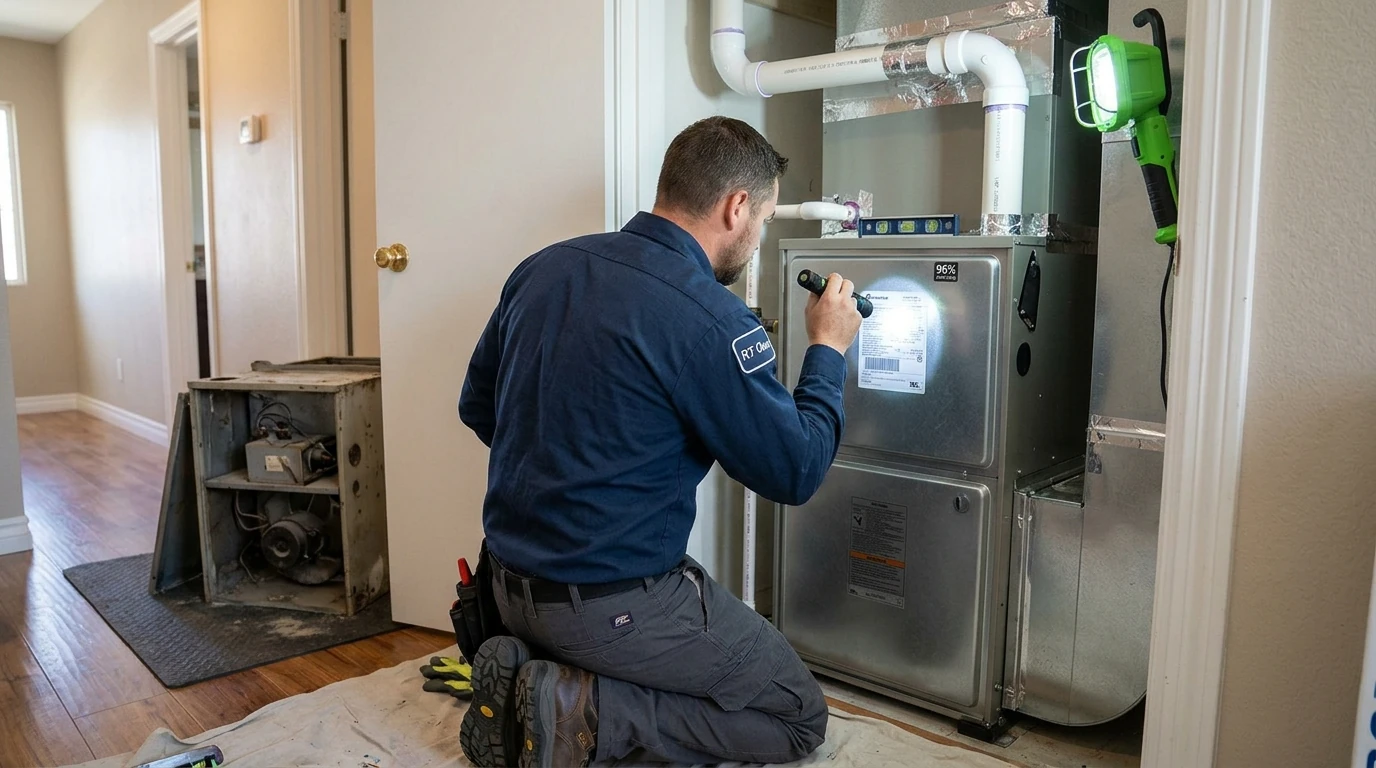
TL;DR: A new gas furnace installed in a Corona home typically costs $3,800 to $6,500 for a standard 80% AFUE single-stage unit, and $6,500 to $11,000 or more for a high-efficiency 96% AFUE two-stage or variable-speed model with new PVC intake and exhaust venting. Most Corona homes run a forced-air furnace in a hallway closet or attic, and that access point changes labor time and price. Riverside County and the City of Corona both require a mechanical permit for any furnace change-out.
If a technician just told you your furnace needs a new heat exchanger or control board and the repair bid is creeping toward $1,800, you’re in the right spot to weigh that number against a full replacement instead of guessing. Corona’s housing stock, from the older tract homes near Eagle Glen to newer builds around Dos Lagos, mostly runs forced-air gas furnaces tucked into a hallway closet or pulled up into the attic, and that location changes both the labor and the price. Here’s what a straight swap actually runs, what efficiency rating buys you, and what the county requires before a new unit gets fired up.
How Much Does Furnace Replacement Cost in Corona, CA?
A full furnace replacement in Corona runs $3,800 to $6,500 installed for a standard 80% AFUE unit, and $6,500 to $11,000 or more for a 96% AFUE high-efficiency furnace, depending on BTU size, ductwork condition, and whether the install needs new venting.
The equipment itself is a smaller piece of that number than most homeowners expect. A mid-size 80,000 BTU furnace might run $1,200 to $2,500 on its own; the rest covers labor, a new flue or PVC vent kit, a condensate pump if the unit is high-efficiency, disposal of the old furnace, and startup and testing.
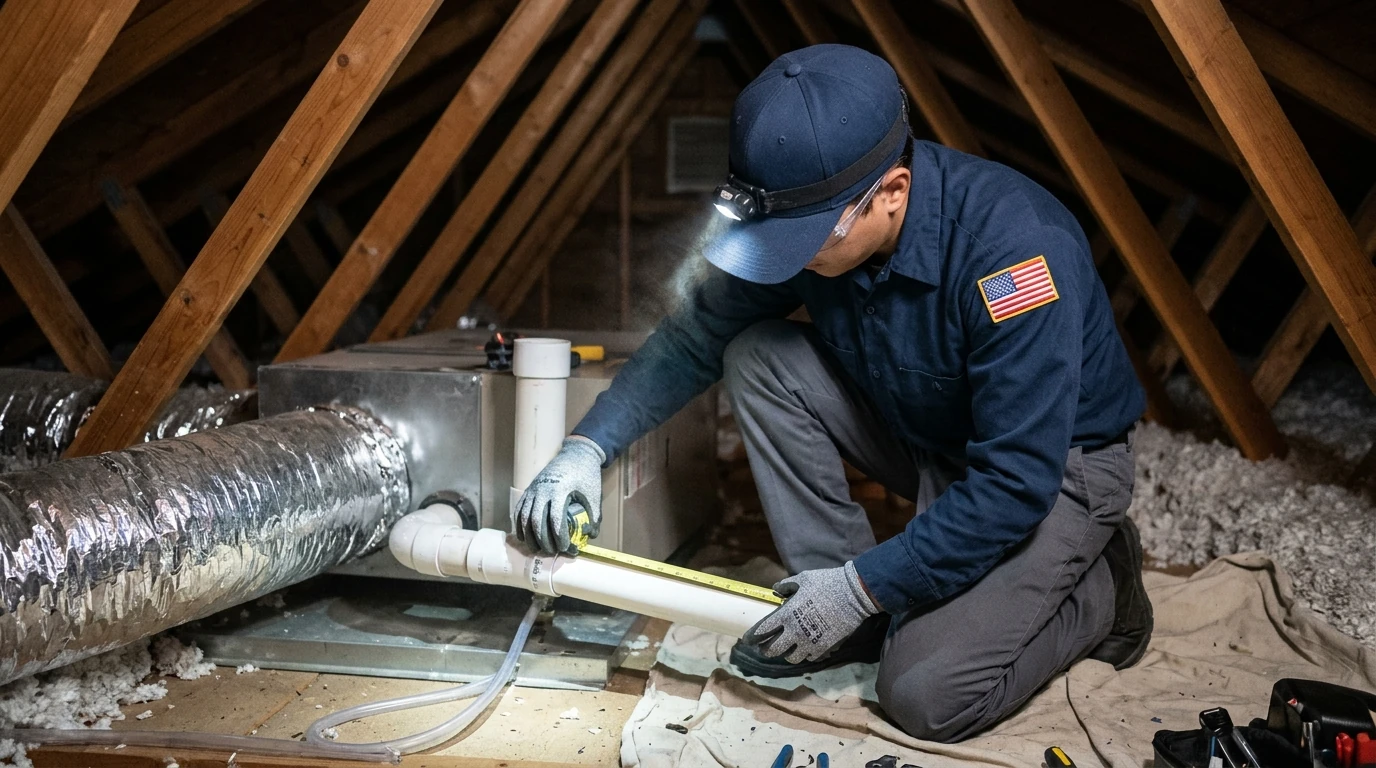
Closet installs in older Corona homes often land on the lower end of the range because the space and gas line are already sized correctly. Attic installs, common in homes built from the late 1980s onward, usually cost more: the crew works in tight, hot space, and the furnace, plenum, and any duct transitions have to be carried up through an attic hatch.
If the existing ductwork is undersized, leaky, or was never sealed, adding duct sealing or a few new runs adds to the total. A written quote should spell out the furnace model and AFUE rating, labor, venting, permit fee, and whether ductwork is included, so you’re comparing two bids on the same scope.
What’s the Difference Between an 80% and 96% AFUE Furnace?
AFUE stands for annual fuel utilization efficiency: an 80% AFUE furnace turns 80 cents of every gas dollar into heat and vents the rest out a metal flue, while a 96% AFUE furnace extracts almost all of it and vents through PVC pipe because the exhaust runs cool enough not to melt plastic.
That venting difference is a big reason 96% furnaces cost more to install, not just to buy. A metal flue that already runs through the roof can sometimes be reused for an 80% AFUE swap. A 96% AFUE furnace needs new PVC intake and exhaust lines routed to an exterior wall or roof, plus a condensate drain, since the unit produces water as it condenses the exhaust.
In a climate like Corona’s, where the heating season is short compared to colder states, the extra few thousand dollars for a 96% AFUE unit pays back more slowly in gas savings than it would somewhere that runs the furnace five months a year. It still makes sense for homeowners planning to stay long-term, or replacing a furnace that also serves a large, hard-to-heat floor plan. For current efficiency criteria, look for the blue ENERGY STAR label on the unit before signing a quote.
Do You Need a Permit to Replace a Furnace in Corona?
Yes. Riverside County and the City of Corona both require a mechanical permit for any furnace change-out, and the permit triggers an inspection of the gas connection, venting, and combustion air before the job is considered finished.
The permit isn’t paperwork for its own sake. An inspector checks that the vent pipe has the right slope and clearance, that the gas line is sized and tested correctly, and that the unit has enough combustion air in a closet install, items covered under the Uniform Mechanical Code that California cities adopt locally through IAPMO. Skipping the permit can cause problems later: at resale, an unpermitted furnace change-out is something a home inspector will flag.
A licensed contractor pulls the permit as part of the job and schedules the inspection; it shouldn’t be something you have to chase down yourself. You can verify any contractor’s license status directly through the CSLB license lookup tool before work starts.
How Do You Know It’s Time to Replace Instead of Repair?
Replacement usually makes more sense once a furnace has a cracked heat exchanger, or needs a repair that costs a large share of what a new unit would run installed.
A cracked heat exchanger is the clearest line: it’s a safety issue, not just a wear item, because it can let combustion gases mix into the air supply, and most techs will recommend replacement over repair on sight. Repeated igniter, flame sensor, or control board failures on an older unit are a softer signal that the furnace is wearing out across the board, even if each individual fix is affordable on its own.
For the full breakdown of how to weigh a specific repair quote against replacement cost, see our furnace repair or replace guide. If you’re still in diagnosis mode and want current repair pricing for comparison, our furnace repair cost guide for Corona covers what the common fixes run.
Does a Heat Pump Make More Sense Than a Gas Furnace Here?
For most Corona homes, a straight gas furnace replacement is still the simpler path, but a heat pump is worth pricing out if you’re also due for AC replacement, since one system handles both heating and cooling.
Corona’s mild winters are a genuinely good climate for an air-source heat pump: unlike colder regions, it rarely has to work against freezing outdoor temperatures, which is where heat pump efficiency drops off. The tradeoff is upfront cost and, for an all-electric setup, a changed utility bill mix, more electric, less gas. A dual-fuel system that pairs a heat pump with a gas furnace as backup is another option worth a quote if you want efficiency without giving up gas heat on the coldest nights. The Department of Energy’s heat pump guide is a solid starting point for understanding how the technology performs in a climate like Southern California’s.
If your AC is also aging, it’s worth getting a quote for furnace-only replacement side by side with a heat pump system quote before deciding, since combining the jobs often saves on labor compared to doing them separately down the road.
A furnace replacement is one of those jobs where the written quote matters as much as the price on it: make sure it names the AFUE rating, the BTU size matched to your home, the permit, and what happens to the old unit. RT Olson Plumbing, Heating and Air Conditioning has handled furnace swaps across Corona’s closets and attics since 2014, and can walk through those numbers for your specific system. Request a furnace replacement quote or call RT Olson at (951) 344-5596 to get a technician out to look at the actual unit.
About RT Olson Plumbing, Heating and Air Conditioning
RT Olson Plumbing, Heating and Air Conditioning is a licensed plumbing and HVAC contractor (CSLB license #997337) serving Corona, CA since 2014, with a second office in Anaheim covering Orange County. The company holds a 4.9 Google rating across 624 reviews and runs 24/7 service across plumbing, heating, and air conditioning calls. This guide was prepared with RT Olson’s furnace install team, led by Bob Olson.