TL;DR: Typical installed prices: basic systems about $600 to $1,500, mid-range systems about $1,500 to $3,000, and high-capacity or whole-home systems about $3,000 to $6,000 or more. Most single-family homes land in the $1,500 to $3,000 range, usually including installation. Ongoing costs are low: salt runs about $5 to $10 a bag, and the electricity use is negligible.
If you’re staring at a crusty white ring around a faucet, or your dishwasher keeps leaving spots no matter what detergent you buy, you’re probably dealing with hard water and wondering whether a water softener is worth the money. It usually is, but the price swings a lot depending on your home’s size, your water’s hardness, and how the unit gets installed. Here’s what actually drives the number.
How much does a water softener cost in Corona, CA?
Typical installed costs, equipment plus professional installation:
- Basic systems: about $600 to $1,500
- Mid-range systems: about $1,500 to $3,000
- High-capacity or whole-home systems: about $3,000 to $6,000 or more
Most single-family homes fall in the $1,500 to $3,000 range. Where yours lands depends on the type of system (salt-based, salt-free, or a dual-tank system for larger households), your home’s size and water use, and what the installation requires. Many Corona homeowners deal with hard water every day, but hardness varies, so a water test and a customized evaluation are the only way to get an accurate price for your home.
What determines how much your water softener will cost?
The three biggest cost drivers are your household’s grain capacity requirement, your water’s hardness and mineral content, and how complicated the installation is.
Sizing by grains per gallon (GPG). Water softener capacity is measured in grains, based on how many grains of hardness the resin bed can remove before it needs to regenerate. The average person uses about 80 gallons of water a day. Multiply that by the number of people in your home, then by your water’s hardness in GPG, and you get your daily grain removal requirement. A four-person household at 10 GPG (a commonly cited U.S. average) needs to remove roughly 3,200 grains a day, which points to a system around 24,000 grains. The largest residential systems go up to about 80,000 grains. Our guide on how to size a water softener walks through the math.
Water hardness and mineral content. Your water provider’s annual water quality report will list hardness for municipal supplies. If you’re on a well, a test kit or an independent lab will give you an accurate read, and a lab has no incentive to upsell you on a bigger system than you need. Iron and manganese matter too. For every 1 part per million (ppm) of iron, add 4 GPG to your sizing number. Do the same for manganese.
Installation complexity. Price also depends on where your main water line enters the house, whether there’s a nearby drain for the system’s backwash discharge, and whether an electrical outlet is already in place near the installation point. Older homes sometimes need rerouted plumbing or a new drain tap, which adds labor.
Is a water softener worth the cost?
For most homes with moderately to very hard water, yes. A softener’s cost is offset over time by less wear on appliances and lower soap and detergent spending. Hard water itself is non-toxic, and there is no evidence it causes health problems, but the mineral buildup it leaves in your plumbing is genuinely expensive over time.
Hard water leaves scale inside pipes, water heaters, washing machines, and dishwashers, which shortens their working life and makes them run less efficiently. A water heater’s heating element or burner has to work harder to push heat through a layer of scale, so soft water often means a modest drop in water heating costs too. Soft water also lets soap and detergent lather fully instead of binding to dissolved minerals, so you use less of both, and clothes and dishes come out without the gray film or spotting hard water causes.
How long does a water softener last?
Most water softeners last 10 to 15 years before the resin bed or control valve needs replacing. Higher-end systems with better-built control heads sometimes run longer. The biggest factor in lifespan is how much soft water the system produces: a household with heavy water use puts more cycles on the resin and valve than a lighter-use home. Warranty length is a reasonable proxy for how long a manufacturer expects a given model to hold up, so it’s worth comparing warranties, not just sticker price, when you shop.
Which type of water softener is best?
For most homes, an ion-exchange (salt-based) softener is the best choice because it actually removes hardness minerals rather than just altering them. Salt-free conditioners are the right call where sodium-based systems are restricted or where residents are on a low-sodium diet. Magnetic or electric “softeners” are not a substitute for either.
Ion-exchange systems use a resin bed that holds a negative charge, pulling calcium and magnesium (which carry a positive charge) out of the water as it passes through. Periodically, the system regenerates: a backwash flush clears out the collected minerals, then a brine solution recharges the resin with fresh sodium or potassium ions. Systems regenerate on a meter (based on actual water use, so there’s no waste) or on a timer (a fixed amount every day, which is more common but less efficient). If you want the mechanics in more detail, we’ve broken down how a water softener works step by step.
Sodium is the cheaper regenerant; potassium costs considerably more per bag. Potassium is easier on septic systems and better for sodium-restricted diets (check with a physician if that applies to you). Some local code amendments restrict self-regenerating, sodium-based softeners for homes on septic systems, so it’s worth confirming local rules before you buy.
Salt-free conditioners don’t remove minerals; they crystallize them so they can’t bind to pipe walls or fixtures. They need no salt and little maintenance beyond replacing filter media every one to two years, but they don’t technically soften water the way an ion-exchange system does.
Magnetic or electric units that clamp onto existing pipes are the cheapest option, but they are controversial: some users are satisfied, while studies by some water-testing associations say they don’t work. The minerals stay in the water and still scale appliances and water heaters over time. We don’t recommend one in place of an actual softening system.
What will a water softener cost you every month?
If you buy a system outright, the main ongoing cost is salt (about $5 to $10 a bag; potassium costs more), usually refilled about once a month. Electricity use is negligible, and it can be partly offset because a water heater works more efficiently with soft water. Annual maintenance is minimal with a proper setup.
Renting usually costs more over time. Monthly rental payments run for as long as you keep the system, so over a softener’s 10 to 15 year life you can pay well over the cost of buying one outright, for equipment you never own, and rented equipment is often used with limited choices. Renting makes sense if you want to try a system before committing, but financing or buying almost always costs less over the long run.
How much does it cost just to install a water softener?
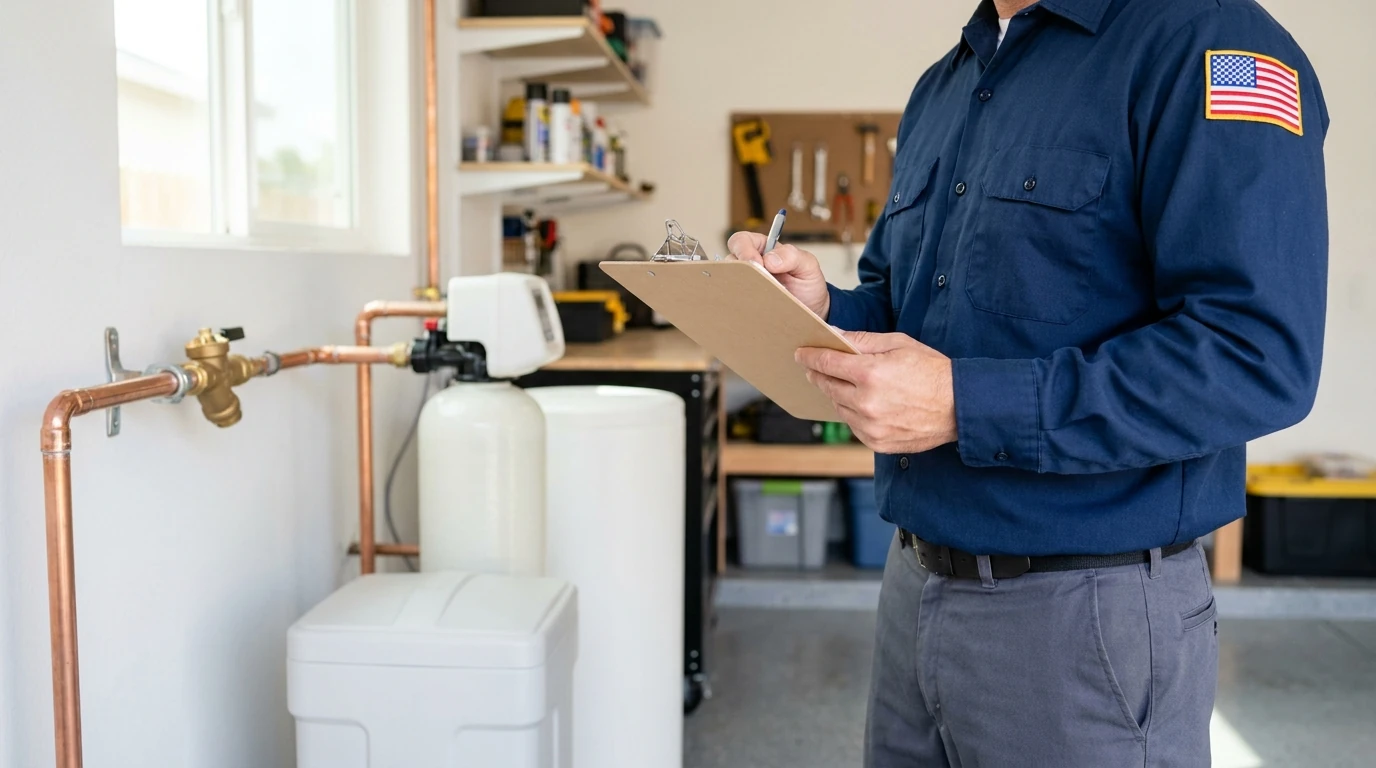
Installation is usually included in a quoted system price. What drives the installation portion is your existing plumbing setup, how accessible the installation area is, and whether upgrades or modifications are needed. The work covers connecting the bypass valve, tying the unit into your main line, running a backwash line to an approved drain, and verifying the system regenerates correctly once it’s pressurized. Ask for a quote that separates equipment from labor so you can compare bids.
When does a water softener installation need a licensed plumber?
Nearly every softener installation needs a licensed plumber, because the job involves cutting into your home’s main water supply line and tying a backwash discharge into an approved drain, both of which fall under local plumbing code. A sloppy main-line tie-in or drain connection can leak or let backwash water go where it shouldn’t. RT Olson Plumbing, Heating and Air Conditioning sizes and installs water softening and filtration systems for homes throughout Corona and the surrounding Inland Empire, matching the unit to your household’s actual water test results rather than a generic size chart.
If your fixtures are showing scale, your soap isn’t lathering, or you just want an accurate sizing estimate based on a real water test, request a water softener quote and bring along a recent water bill or well test result so the sizing is right the first time.
About RT Olson Plumbing, Heating and Air Conditioning
RT Olson Plumbing, Heating and Air Conditioning has served Corona, CA and the surrounding Inland Empire since 2014, holding California contractor license #997337 (verify any contractor’s license at cslb.ca.gov). The company offers 24/7 service and holds a 4.9-star Google rating across more than 600 reviews. This guide first ran on RT Olson’s previous website and was updated for Corona homeowners in October 2026.
Need help now? Call RT Olson Plumbing, Heating and Air Conditioning at (951) 344-5596.