
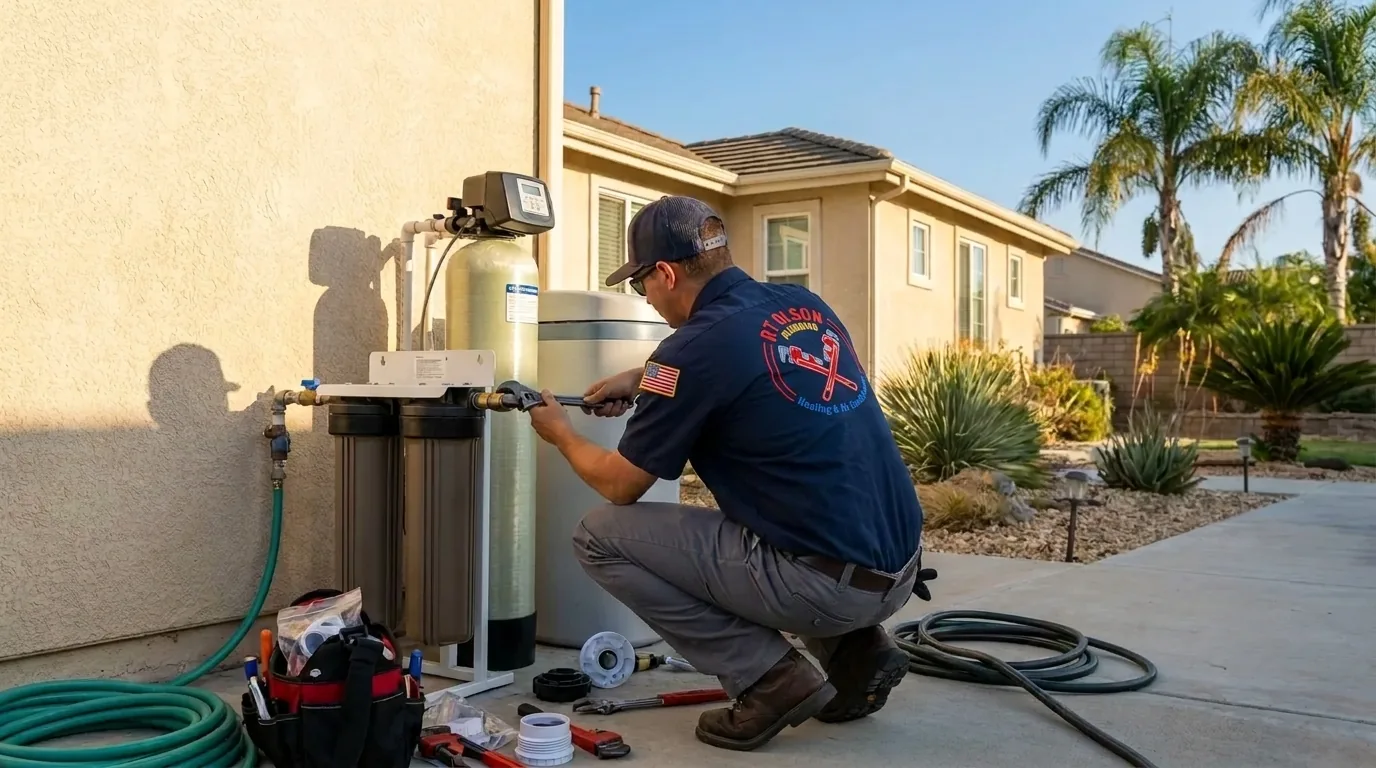
Water Softeners and Filtration Systems in Corona
Trusted water softeners and filtration systems in Corona and surrounding areas. Licensed and insured plumbing and HVAC pros, upfront pricing, free estimates. Call (951) 344-5596.
If your showerhead is crusted with white scale, your soap refuses to lather, and your water heater is working harder than it should, Southern California’s notoriously hard water is almost certainly the cause. The Inland Empire draws from groundwater and imported Colorado River supplies that routinely test above 300 mg/L of dissolved calcium and magnesium, well into the “very hard” range. A properly sized and installed water softener or whole-house filtration system stops that mineral load at the point of entry, protecting your plumbing, appliances, skin, and water-using fixtures before damage compounds.
What water softeners and filtration systems actually involve
These are two distinct technologies that are often combined, and understanding the difference matters before anything gets installed.
Ion-exchange water softeners replace calcium and magnesium ions with sodium ions using a resin tank regenerated by a brine solution. They address hardness specifically, the scale on your faucets, the film on your dishes, the shortened lifespan of your water heater element. A properly sized softener is rated in grains per gallon (GPG) of hardness and matched to your household’s daily water use. Undersizing is one of the most common installation mistakes; a tank that regenerates too frequently wastes salt and water, while one that regenerates too rarely lets hardness break through.
Whole-house filtration systems address a broader range of contaminants, sediment, chlorine, chloramines (which Southern California municipal suppliers use as a secondary disinfectant), volatile organic compounds, and in some cases heavy metals. These systems use sediment pre-filters, activated carbon media, and sometimes KDF (kinetic degradation fluxion) media staged in sequence.
Reverse osmosis (RO) systems are point-of-use systems typically installed under the kitchen sink. They push water through a semi-permeable membrane that removes dissolved solids, nitrates, arsenic, and most other contaminants to near-zero levels. RO is the right answer for drinking and cooking water quality; it is not practical as a whole-house solution because of its flow rate and waste-water ratio.
Installation involves a water quality test, equipment selection, a bypass valve, proper drain connections for softener brine discharge, and, for RO, a dedicated faucet and connection to the refrigerator line if desired. Most installations are completed in a single visit.
Our process
-
Water quality assessment. Before recommending any equipment, we test your water for hardness (GPG), total dissolved solids (TDS), pH, chlorine/chloramine levels, and any site-specific concerns like iron or sediment. Corona’s water supply characteristics vary depending on whether your home is on a municipal feed or a well-influenced blend, and the test drives every equipment decision that follows.
-
System sizing and selection. We calculate your household’s peak daily demand, match softener capacity in grains to your actual hardness load, and select filtration media appropriate to your contaminant profile. We present options at different price points and explain the trade-offs plainly, not every home needs a multi-stage whole-house system, and we will tell you if a simpler solution fits your situation.
-
Installation and bypass plumbing. Equipment is installed on the main supply line after the meter and before your water heater, with a code-compliant bypass valve so you can isolate the system for service without shutting down the house. Brine drain lines for softeners are routed to an appropriate standpipe or utility drain. All connections are pressure-tested before we leave.
-
System programming and salt/media load. Softener control valves are programmed for your specific regeneration schedule, typically demand-initiated rather than time-clock, which conserves salt and water. We load the brine tank, set the hardness offset, and walk you through the control panel so you are not guessing at the settings six months from now.
-
Post-installation water test and documentation. We run a final hardness test at the tap to confirm the system is performing to spec. You receive documentation of your pre- and post-installation water quality readings, equipment model and serial numbers, and the manufacturer warranty information.
What separates a good installation from a bad one
The most common failure point is incorrect sizing. A softener rated for a two-person household installed in a five-person home will run through its resin capacity before the programmed regeneration cycle kicks in, letting hard water pass untreated. The fix is a proper pre-installation water test and a realistic calculation of daily water use, not a guess based on bedroom count.
The second common mistake is skipping the bypass valve. Without one, any service call or equipment failure means shutting off water to the entire house. Code in California requires a bypass on softener installations, and any installation without one is both a code violation and a practical headache.
For filtration systems, mismatched media is the recurring problem. Activated carbon removes chlorine effectively but does almost nothing for dissolved minerals. A homeowner who installs a carbon-only system expecting softened water will be disappointed. Conversely, a softener does not remove chloramines, if taste and odor are the complaint, a carbon stage is what addresses it. A thorough water test before equipment selection prevents this mismatch entirely.
For RO systems, membrane neglect is the long-term failure mode. Membranes have a finite service life and need replacement on a schedule tied to your TDS load. An expired membrane passes more and more dissolved solids while still appearing to work, and most homeowners have no way to know without periodic TDS testing at the RO tap.
Seasonal and regional considerations
Southern California’s water hardness is not constant year-round. During wet winters when local reservoirs contribute more to the municipal blend, hardness levels can drop modestly. During dry stretches when the system leans harder on Colorado River imports, hardness climbs. If your softener was programmed during a wet season and never adjusted, it may be under-treating during summer months when the hardness load peaks.
Corona and the surrounding Inland Empire also sit in a region where water agencies have historically blended groundwater with imported surface water, and the ratio shifts with drought conditions and conservation mandates. Periodic water testing, not just at installation, is the only reliable way to know whether your system is keeping pace with what’s actually coming out of the ground and the aqueduct.
Service area
RT Olson Plumbing, Heating and Air Conditioning is based in Corona and installs and services water softeners and filtration systems throughout the surrounding Inland Empire and Riverside County communities, including Norco, Eastvale, Chino, Chino Hills, Ontario, Riverside, Jurupa Valley, and Mira Loma. Dedicated service pages for each city link back here with local water quality notes specific to those municipal supplies.
If your water is leaving its mark on your fixtures, your dishes, or your water heater, call RT Olson Plumbing, Heating and Air Conditioning at (951) 344-5596 to schedule a water quality assessment and get a written equipment recommendation, no pressure, no upsell, just a clear picture of what your water actually contains and what it would take to treat it.
Services We Handle
- Filter Replacement
- Free Water Test
- Water Conditioners
- Water Filter Systems
- Water Filtration Systems
- Water Testing
- Whole House Water Filter
- Whole House Water Filter Systems
- Whole House Water Filtration
- Whole House Water Filtration System
Frequently Asked Questions
Does homeowners insurance cover water softener or filtration system installation?
How do I know whether I need a water softener, a filtration system, or both?
How often does a water softener need to be serviced or have its salt refilled?
What is the difference between a salt-based water softener and a salt-free water conditioner?
How long does a reverse osmosis membrane last, and how do I know when it needs replacement?
Looking for the best water softeners and filtration systems company in Corona?
RT Olson Plumbing, Heating and Air Conditioning provides licensed and insured water softeners and filtration systems in Corona, CA and the surrounding area, and has served local property owners since 2014. Customers rate us 4.9 out of 5 stars across 619 Google reviews. We answer calls 24/7 — call (951) 344-5596 for immediate help.
Need Water Softeners and Filtration Systems now?
We respond 24/7 across Corona and surrounding CA cities.
Related Coverage
- Our Plumbing Services, Plus Heating & Air
- Contact RT Olson Plumbing, Heating and Air Conditioning
- Water Softeners and Filtration Systems in Anaheim
- Water Softeners and Filtration Systems in Chino
- Water Softeners and Filtration Systems in Fullerton
- Water Softeners and Filtration Systems in Norco
- Water Softeners and Filtration Systems in Ontario
- Water Softeners and Filtration Systems in Riverside
- Water Softeners and Filtration Systems in Santa Ana
- Water Softeners and Filtration Systems in Yorba Linda
- Water Treatment in Corona, CA: Softeners, Filters, and RO Systems Explained