
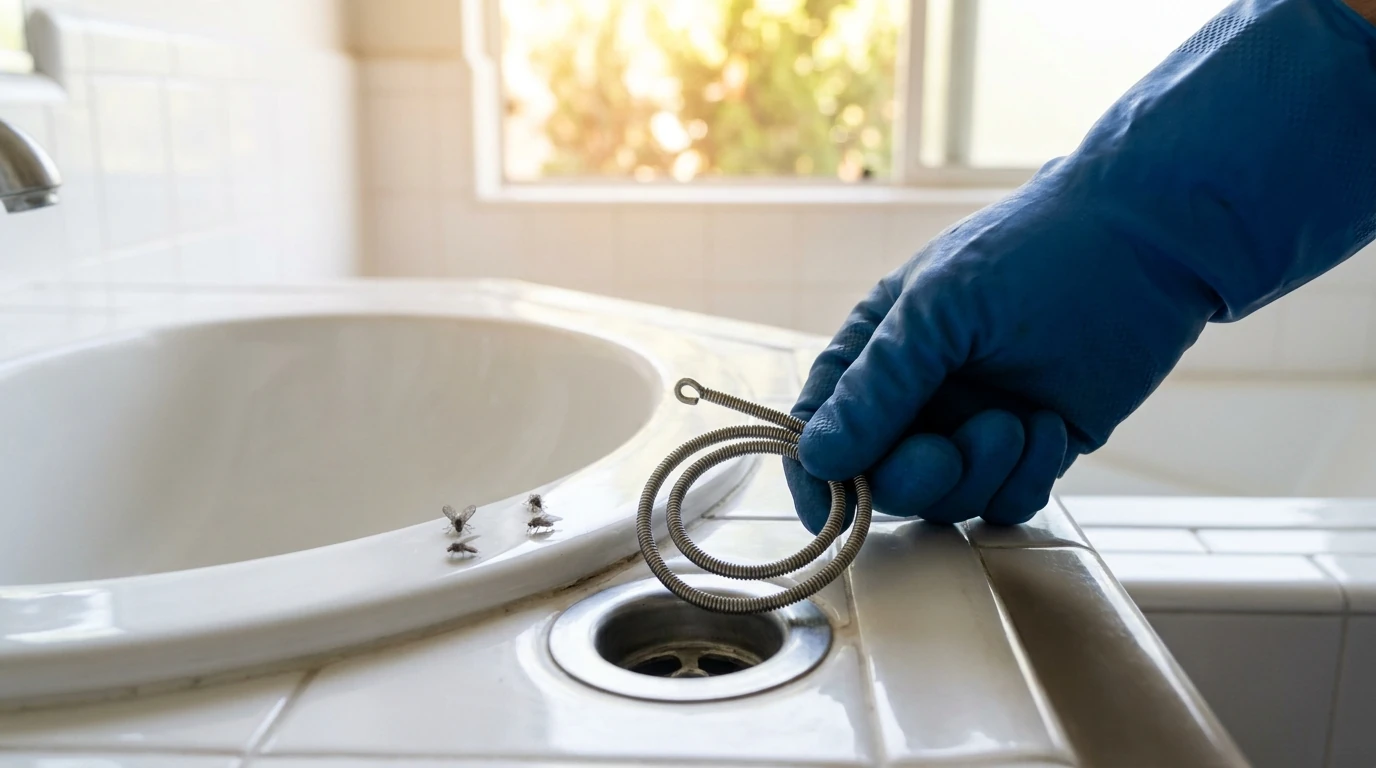
TL;DR: Drain flies (also called sewer gnats) breed in the slimy organic buildup, or biofilm, lining a slow or clogged drain. Boiling water, or a baking soda, salt, and vinegar flush, usually clears a light infestation in a couple of days. Bleach kills adult flies on contact but rarely penetrates the biofilm where eggs and larvae live, which is why they often come back within a week. If flies return after repeated treatments, the real problem is the clog feeding them, not the flies themselves.
If you’re standing at your bathroom sink right now staring at a cluster of tiny, fuzzy, moth-like flies on the wall above the drain, you’re not imagining things and you’re not dealing with a pest infestation that started outside. These are almost certainly drain flies, and they’re living inside your plumbing. The good news: getting rid of them is usually a weekend job, not a call to an exterminator, as long as you treat the clog and not just the bugs sitting on your tile.
What Is a Drain Fly?
A drain fly is a tiny, gray, fuzzy-bodied insect, usually 4 to 10 millimeters long, that breeds in standing water and organic sludge inside drain pipes. People also call them sewer gnats or bathroom moth flies, and they’re easy to mistake for fruit flies at a glance.
Up close, drain flies have a moth-like, hairy appearance rather than the smooth, shiny body of a fruit fly. Like house flies, they have six legs, a pair of wings, and antennae, but they are so small that you would need a magnifying glass to see most of those details.
Adults gather and mate where there is standing water, and they lay eggs directly in the gunk coating the inside of a pipe: hair, soap scum, grease, and food debris that didn’t fully wash down. The larvae hatch and feed on that organic layer, and as they mature the adult flies leave the drain in search of more food. Their whole life cycle is short, which is why a small problem can turn into a cloud of flies quickly.
What Causes Drain Flies in a Corona Home?
Drain flies show up because a drain somewhere in the house has standing water and organic buildup, almost always a slow or partially clogged line. Find the clog and you find the breeding site.
The pattern we see most often in Corona is a drain that doesn’t get used much: a guest bathroom shower that sits idle for weeks, a laundry room floor drain, or a single-occupant home where one bathroom only sees light daily use. Without regular water flow, the biofilm layer builds up undisturbed and becomes an ideal nursery.
Southern California’s hard water doesn’t help. Mineral scale roughens and narrows the inside of a pipe over time, giving hair, grease, and soap scum more surface to cling to. Older Corona homes that still have original cast-iron drain lines are especially prone to this kind of buildup, but any drain can trap debris around a P-trap or a garbage disposal.
If you’re seeing drain flies, there’s a clog somewhere in your system. It might be minor today, but it’s worth checking the drain’s flow rate at a minimum.
How Long Does It Take To Get Rid Of Drain Flies?
Most light drain fly problems clear up in a couple of days once you treat the clog and kill the existing larvae. A single treatment is rarely enough on its own if the underlying buildup isn’t disturbed.
Boiling water poured down the affected drain, or a baking soda and vinegar flush, will usually knock out a fresh infestation within a couple of days. If the kitchen is the source, check for forgotten fruit or vegetables on the counter or in the disposal first, since those can be their own breeding ground separate from the drain itself.
If flies are still showing up after a few days of treatment, the biofilm wasn’t fully cleared and a new generation has already hatched. At that point, repeating the same home remedy usually just delays the problem instead of solving it.
Does Bleach Kill Drain Flies?
Bleach kills adult drain flies on contact and some of the larvae near the surface, but it rarely fixes the problem for good because it doesn’t break down the biofilm where most of the eggs are protected.
Here’s the mechanism: biofilm is a sticky coating of bacteria, soap residue, and organic debris clinging to the inside of the pipe wall. When you pour bleach down a drain, it tends to flow through quickly and dilute in any standing water rather than soaking into that layer. It kills what it touches on the surface, and the flies you can see usually die off within a few hours to a day. But eggs and larvae embedded deeper in the buildup often survive, which is why a colony can reappear within a week even after a bleach treatment that seemed to work.
Bleach also isn’t an option if your home is on a septic system. Septic tanks rely on a bacterial environment to break down waste, and a strong dose of bleach can kill off those microbes and disrupt the whole system.
A gentler, often more effective alternative: combine 1/2 cup salt, 1/2 cup baking soda, and 1 cup white vinegar, pour it down the drain, let it sit overnight, then flush with boiling water the next morning. This loosens and breaks down organic buildup rather than just poisoning what’s on the surface, and it’s easier on older pipes and septic systems than bleach.
If you’ve tried bleach or the baking soda method more than once and the flies keep coming back, the biofilm layer is thicker than a home remedy can reach, and that’s usually a sign mechanical cleaning, like drain snaking or hydro jetting, is the next step. We cover how those two methods compare in hydro jetting vs snaking.
Drain Flies vs. Fruit Flies: How Do You Tell Them Apart?
Drain flies have a fuzzy, moth-like body and rest on walls near the sink or shower; fruit flies have a smooth, shiny body and swarm around produce, trash cans, and recycling bins.
If you’re seeing the insects mostly inside the shower or clustered on the wall above a bathroom sink, that’s a strong sign they’re drain flies emerging from the pipe. If they’re swarming a fruit bowl, an open trash can, or an empty wine bottle, you’re more likely dealing with fruit flies, which breed in rotting produce and fermenting liquid rather than pipe buildup.
It’s worth checking both possibilities before you commit to drain treatments. Wine corks with leftover liquid, forgotten produce, and recycling bins with sticky residue can all host fruit flies even in a kitchen with perfectly clean drains.
When Is It a Drain Problem Instead Of A Bug Problem?
It’s time to call a plumber when drain flies keep coming back after two or more rounds of home treatment, or when the drain they’re coming from is also running slow, gurgling, or backing up.
Repeated reinfestation almost always means the clog is deeper or larger than a kitchen remedy can reach, or that there’s more than one breeding site in the line. The usual culprits are a partial clog trapping organic debris, a damaged drain trap, buildup in the sewer line, or a hidden moisture problem. In older Corona homes with original cast-iron or Orangeburg sewer laterals, buildup inside the line is a common reason the problem keeps returning.
At that point, a professional drain cleaning clears the organic buildup the flies are actually living in, rather than just killing the current batch of adults. A technician can also run a camera down the line if the clogging is recurring, to rule out a bigger issue like a cracked or root-intruded sewer lateral. RT Olson Plumbing, Heating and Air Conditioning handles exactly this kind of drain and clog inspection across Corona and the surrounding Inland Empire, and our drain cleaning service is built to clear the buildup at the source instead of just treating symptoms.
If you’re not sure whether your situation calls for a DIY flush or a professional visit, our breakdown of chemical drain cleaners vs calling a plumber walks through where that line usually falls.
A clog that keeps breeding flies isn’t going to resolve itself, and the longer it sits, the more buildup accumulates for the next colony. Call RT Olson Plumbing, Heating and Air Conditioning at (951) 344-5596 to schedule a drain inspection if home remedies haven’t held.
About RT Olson Plumbing, Heating and Air Conditioning
RT Olson Plumbing, Heating and Air Conditioning has served Corona, CA and the surrounding Inland Empire since 2014, holding California contractor license #997337 (verify any contractor’s license at cslb.ca.gov). The company offers 24/7 service and holds a 4.9-star Google rating across more than 600 reviews. This guide first ran on RT Olson’s previous website and was updated for Corona homeowners in October 2026.