
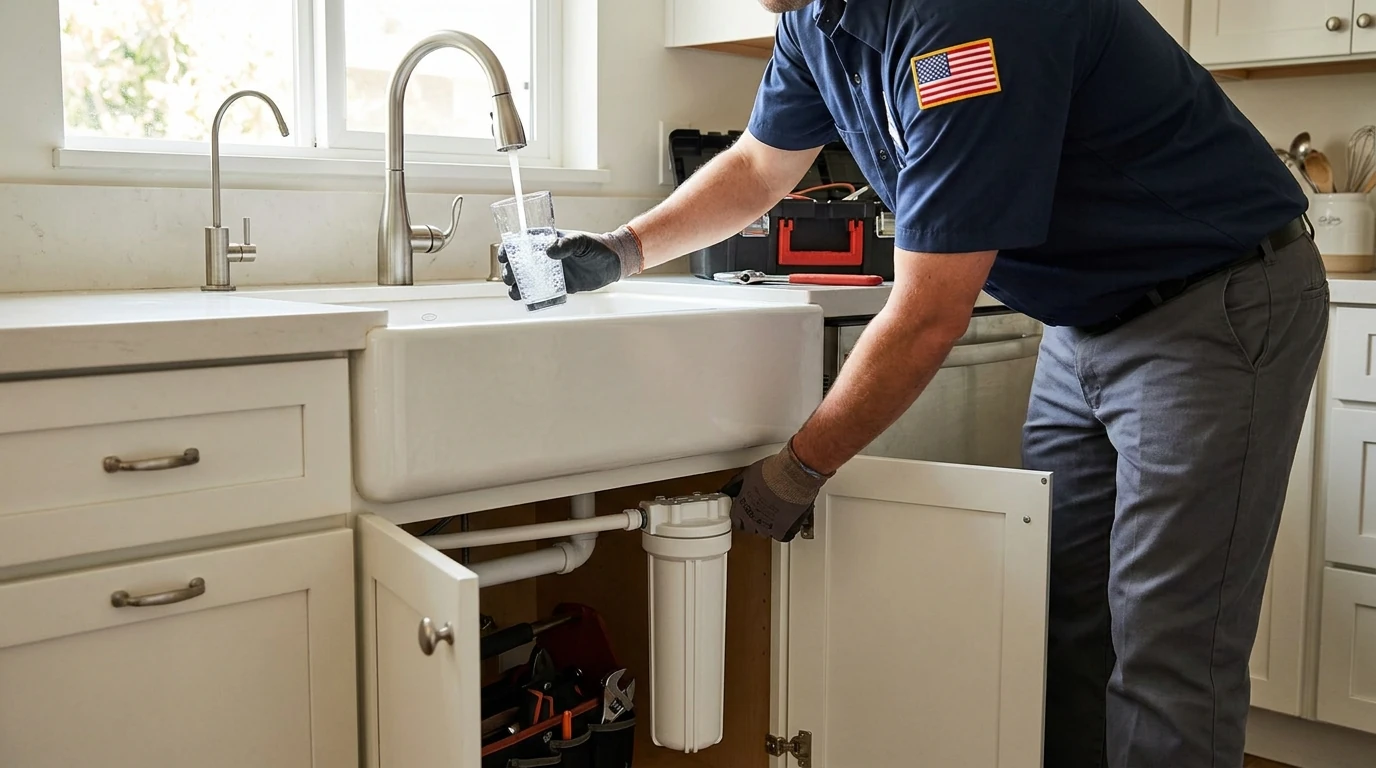
TL;DR: The most effective way to remove chlorine from tap water is a whole-house activated carbon filter, which treats chlorine, chloramine, and many by-products at every tap in the house, paired with an under-sink reverse osmosis (RO) system for drinking and cooking water. Pitcher filters and boiling only handle small amounts of water at a time and do nothing for your shower, laundry, or dishwasher. An inexpensive test strip from a home improvement store will tell you your chlorine level almost immediately.
If your tap water smells like a swimming pool when you fill a glass, or your kids refuse to drink straight from the faucet, chlorine or chloramine is almost always the reason. Water treatment facilities add chlorine, chloramine, and other disinfectants to kill microorganisms and keep the supply safe between the treatment plant and your tap. That protects public health, but it’s also why the water can taste or smell off. Here’s what actually removes it, what doesn’t, and how to decide between a cheap pitcher filter and a whole-house system.
How do you remove chlorine from tap water?
Three methods actually remove chlorine from tap water: activated carbon filtration, reverse osmosis, and distillation. For most households, a whole-house carbon filter paired with an under-sink RO unit is the combination that makes sense, because it treats the entire home without the daily time cost of distillation or the water waste of a whole-house RO system.
Activated carbon works by adsorption: water flows through a bed of porous carbon that traps chlorine, many pesticides, and other dissolved particles as it passes. The principle is old (people have used charcoal to keep stored water fresher for centuries), but modern carbon media is far more effective. A whole-house carbon filter sits where the water line enters the home and treats everything, including showers and laundry.
Distillation, boiling water into steam and condensing it back down, removes chlorine effectively but takes too much time and energy to cover a household’s daily drinking water needs. Reverse osmosis pushes water through a semi-permeable membrane under pressure and is the most thorough filtration available; a small RO unit under the kitchen sink is usually all a family needs, since whole-house RO systems are usually unnecessary, expensive, and waste a lot of water. If microorganisms are a concern, an ultraviolet (UV) filter can be added to a whole-house carbon system.
Do pitcher filters like Brita remove chlorine?
Yes. Brita and similar pitcher or faucet-mount filters use activated carbon and do remove the taste and odor of chlorine from the water that passes through them, along with some other particulates.
The catch is coverage. A pitcher filter only treats the water you pour into it, not the water you cook with, wash dishes in, or shower under. If a test shows elevated chlorine or chloramine throughout your home’s water, a whole-house water filtration system protects every tap instead of just the one glass you refill at the counter.
Does bottled water have less chlorine than tap water?
Not necessarily, and sometimes it has more treatment chemicals than tap water, not fewer. Most bottled water brands aren’t required to publicly disclose their exact purification process, so you often have less visibility into what’s in a bottle than what’s in your tap, which every public water utility must report annually.
Bottling your own filtered or RO water at home is cheaper per gallon than buying it retail and gives you a treatment process you actually know and control.
Does boiling water remove chlorine?
Yes, boiling removes most free chlorine from tap water, but it takes a full, rolling boil of about 15 minutes to do it reliably. That’s not a practical daily habit for most households, and it does nothing for your shower, laundry, or dishwasher water.
It’s also worth knowing that chloramine, the secondary disinfectant some utilities use instead of or alongside chlorine, is more chemically stable than chlorine and does not boil off nearly as easily. If your water smells faintly of chlorine even after boiling, chloramine is a likely reason, and a carbon filter sized for chloramine contact time is the more reliable fix.
How do you test for chlorine in your tap water?
The fastest way to check is a chlorine test strip, sold at most home improvement stores. Dip the strip, wait the few seconds the package specifies, and compare the color change against the included chart to read your chlorine level.
Your local water provider is also a source: under the Safe Drinking Water Act, every public water system has to publish an annual water quality report, often called a Consumer Confidence Report, listing what’s added and at what levels. If you want a more complete picture, a plumber can pull a water sample and test for hardness, chlorine, and other common water issues at the same visit.
What filters remove both chlorine and fluoride?
An under-sink reverse osmosis system is the one common home treatment that reduces both chlorine and fluoride in a single step, because its membrane filters out dissolved ions that carbon media passes through untouched.
Standard activated carbon is excellent at chlorine, taste, and odor, but it isn’t a reliable fluoride filter on its own. If fluoride reduction matters to your household, pair a whole-house carbon filter (for chlorine, chloramine, and by-products everywhere in the home) with an RO system at the kitchen sink for drinking and cooking water.
What are chlorine by-products, and should I worry about them?
Chlorine by-products, mainly trihalomethanes (THMs) and haloacetic acids (HAAs), form when the chlorine used to disinfect water reacts with naturally occurring organic matter in the source water. The EPA sets maximum allowable levels for these compounds under the Safe Drinking Water Act, and utilities are required to stay under them.
A whole-house activated carbon filter reduces by-products the same way it reduces chlorine itself, by adsorbing them as water passes through the media. If by-products are a concern for your household, that’s another point in favor of whole-house filtration over a pitcher that only treats drinking water.
What’s the difference between chlorine and chloramine?
Chloramine is chlorine combined with ammonia, and many utilities use it as a secondary disinfectant because it’s more stable and lasts longer in the distribution system than chlorine alone. It’s still regulated under the Safe Drinking Water Act as safe to drink at allowed levels, but it tends to leave a more persistent taste and odor.
Removing chloramine works through the same carbon filtration principle as chlorine, though it typically needs a catalytic carbon media or longer contact time with the water to work as well. A plumber sizing a whole-house system for your household should account for this if your water provider uses chloramine instead of chlorine.
When is a store filter enough, and when do you need a plumber?
A pitcher or faucet filter is fine if you only care about the taste of your drinking glass. Once chlorine or chloramine odor shows up in your shower, your cooking water, or your laundry, that’s the signal to have a licensed plumber test your water and look at a whole-house system instead of another pitcher cartridge.
This is where the usual combination makes sense: a whole-house carbon filter at the main line, plus an under-sink reverse osmosis system for the kitchen. If hardness is also an issue, a softener can be paired with the filtration stage so you’re solving both problems with one properly sized setup rather than stacking separate gadgets.
If you’re not sure whether your water needs filtration, softening, or both, a water test takes the guesswork out of it. Request a water test and filtration quote from RT Olson Plumbing, Heating and Air Conditioning at (951) 344-5596, and a technician can walk you through what’s actually in your water before recommending equipment.
About RT Olson Plumbing, Heating and Air Conditioning
RT Olson Plumbing, Heating and Air Conditioning has served Corona, CA and the surrounding Inland Empire since 2014, holding California contractor license #997337 (verify any contractor’s license at cslb.ca.gov). The company offers 24/7 service and holds a 4.9-star Google rating across more than 600 reviews. This guide first ran on RT Olson’s previous website and was updated for Corona homeowners in October 2026.