
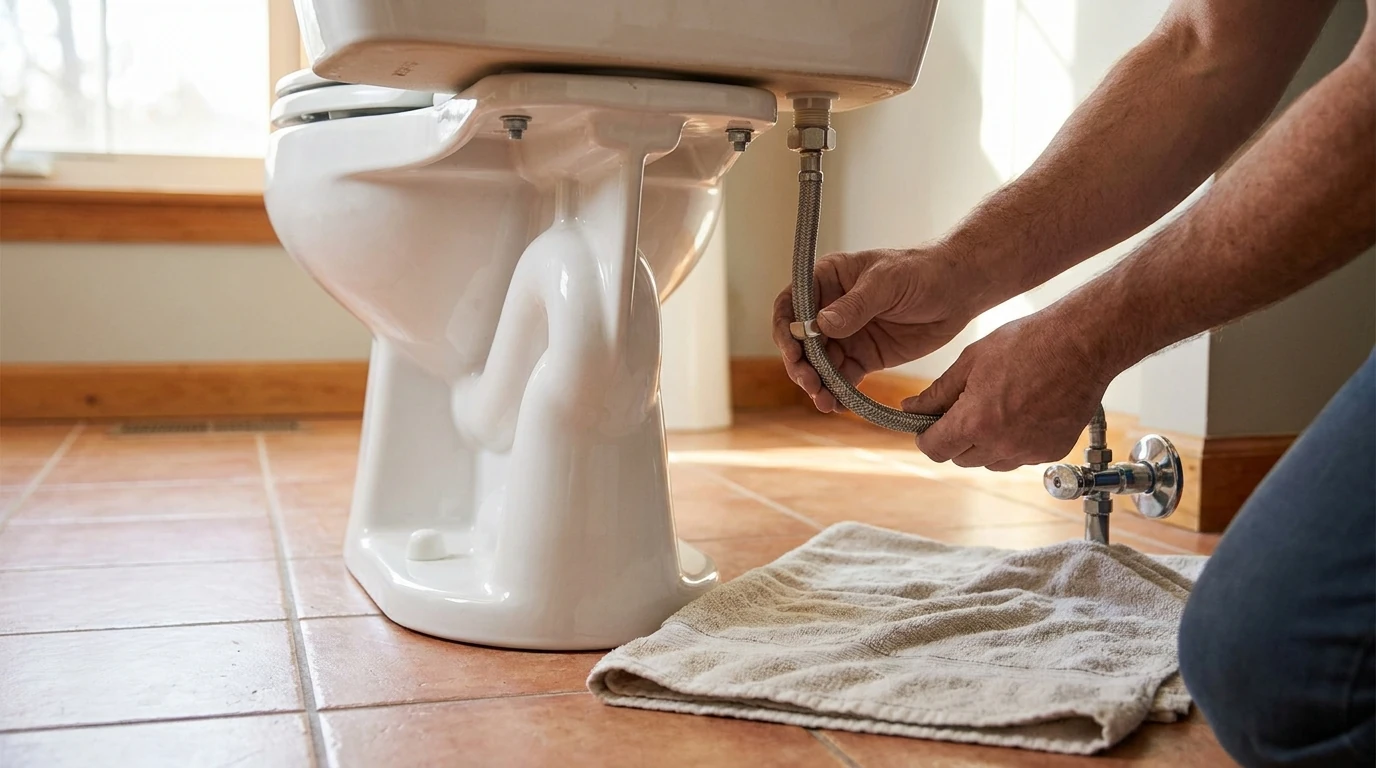
TL;DR: To replace a toilet water supply line, shut off the angle stop valve, flush and sponge out the tank, disconnect the old line with Channellock pliers at both ends, hand-tighten a new braided steel line onto the fill valve and shut-off, then turn the water back on. The job takes under 30 minutes if the shut-off valve itself is in good shape.
If you’ve spotted a rubber supply line under your toilet that’s gone brittle, discolored, or already dripping at the fitting, you don’t need to wait for it to fail completely. Toilet supply lines are one of the most common leak sources in a home, and a line that leaks for long enough can cause real water damage, not to mention a slippery floor at night. Swapping it for a braided steel line is a job most homeowners can finish before their coffee gets cold.
What tools do you need to replace a toilet supply line?
You need a sponge, a bucket, a couple of towels, rubber gloves, and a pair of Channellock pliers. That’s it. No soldering, no special tools, no trip to a specialty plumbing supply house.
Pick up the replacement line while you’re at it. A braided stainless steel or solid brass line holds up far longer than the ribbed rubber or vinyl lines that came standard on older toilets. Rubber lines harden and crack with age and heat cycling; braided lines are rated for much longer service life and resist kinks, which is the other common rubber-line failure mode.
How do you shut off the water and drain the tank?
Turn the angle stop valve at the floor clockwise until the water stops, then flush the toilet and hold the handle down to drain the tank completely. If you can’t get the valve to fully seat, shut off the main water supply to the house instead.
Once the tank is empty, put on rubber gloves and sponge out whatever standing water is left in the bottom of the tank. Wring the sponge into your bucket and repeat until it’s dry enough that nothing will drip on you when you start loosening fittings. Lay towels under the tank anyway. There’s almost always a little trapped water in the line itself, and it tends to find your sleeve the moment you disconnect anything.
How do you remove the old line and install the new one?
Loosen the nut at the shut-off valve with your Channellock pliers, then finish unscrewing it by hand, and repeat the same process at the fill valve nut on the underside of the tank. Both ends should pop free once the nuts are off; expect a small amount of trapped water to drip out.
To install the new line, start at the fill valve: line up the fitting with the threads on the bottom of the tank and hand-tighten it. Don’t crank it down with pliers here, over-tightening a tank fitting is one of the more common ways a simple repair turns into a cracked porcelain tank. Next, connect the other end to the shut-off valve, hand-tighten, then give it a modest final turn with the pliers, snug but not forced. If the new line is longer than the old one and loops slightly once connected, that’s fine as long as there’s no kink or sharp bend in the braiding.
Turn the water back on slowly and watch both connections for a minute. A healthy fitting stays bone dry. If you see a drip at the fill valve, the nut usually just needs a slightly firmer hand-tighten rather than more force from the pliers. Once it holds, replace the tank lid and give the tank a few minutes to refill before the next flush.
When is this a job for a licensed plumber instead?
Call a plumber when the shut-off valve itself won’t turn, won’t fully stop the water, or the valve body is corroded, because at that point you’re no longer swapping a hose, you’re replacing a valve embedded in the supply line behind the wall or floor. The same is true if the tank bolts or fill valve assembly are cracked, if you’re seeing water stains on the floor or ceiling below the bathroom suggesting the leak has been going on longer than you thought, or if your home still has galvanized supply piping feeding that valve.
If you’re not confident shutting off and draining a tank safely, or the valve looks original to a house built decades ago, it’s worth having a technician handle the whole fixture while they’re there. RT Olson Plumbing, Heating and Air Conditioning’s toilet, faucet, and fixture repair technicians can handle a stuck angle stop, a leaking fill valve, or the rest of the fixture.
A secure, modern supply line is cheap insurance against the kind of leak that causes real water damage. If your current line is rubber, more than a few years old, or already showing wear, this is one of the few plumbing upgrades that costs almost nothing and genuinely prevents a bigger problem later.
For a stuck valve, a leaking fill valve assembly, or any toilet repair you’d rather hand off, call RT Olson Plumbing, Heating and Air Conditioning at (951) 344-5596 to schedule a visit.
About RT Olson Plumbing, Heating and Air Conditioning
RT Olson Plumbing, Heating and Air Conditioning has served Corona, CA and the surrounding Inland Empire since 2014, holding California contractor license #997337 (verify any contractor’s license at cslb.ca.gov). The company offers 24/7 service and holds a 4.9-star Google rating across more than 600 reviews. This guide first ran on RT Olson’s previous website and was updated for Corona homeowners in October 2026.