TL;DR: Most garbage disposal clogs sit in the cutting chamber or the discharge pipe, not deep in your home’s drain line. Unplug the unit, remove standing water, check for visible debris with a flashlight, try gentle plunging, and if that fails, open the discharge pipe at the trap to clear it directly. If the disposal hums but won’t spin, or the clog keeps coming back, the problem is likely mechanical or further down the line and needs a plumber.
If you’re staring at a sink full of gray water right now and the disposal just buzzes when you flip the switch, don’t keep running it. A disposal that hums without turning usually has a jammed impeller, not a drain clog, and running it longer can burn out the motor. Unplug it under the sink first, then work through the steps below in order. Most clogs clear in the first three steps.
What tools do you need to unclog a garbage disposal?
You need a shop-vac, a plunger, Channellock pliers, a flashlight, long-nose pliers, a small bucket, and a screwdriver or wrench. All of them are standard hardware-store items, and most homeowners already own at least a plunger and a flashlight.
Before touching anything inside the unit, unplug the garbage disposal at the outlet under the sink, or switch off the breaker if it’s hardwired. This matters more than it sounds: a disposal that is still powered can start up while your hand or tools are in the chamber.
How do you clear the clog yourself?
Start by removing the standing water, then work from the sink down to the discharge pipe until the water drains freely again. Here’s the order that actually works:
- Remove the standing water. Use the shop-vac (filter removed, debris cleaned out first) to suck the water out of the sink. No shop-vac? Bail it out with a cup, then mop up the rest with towels.
- Check for visible debris. With the disposal unplugged, shine a flashlight down into the chamber. If you spot a stuck fork, a bottle cap, or a chunk of produce, pull it out with long-nose pliers. Never reach in with bare fingers.
- Vacuum the cutting chamber. Insert the shop-vac nozzle directly into the drain opening and pull out whatever debris it can reach. Plug the unit back in, run water, and test it. This clears a surprising number of clogs on its own.
- Plunge gently. If water is still backing up, leave a couple inches of standing water in the sink and plunge in short, gentle strokes. Aggressive plunging can damage the pipes and stress the slip-nut joints below.
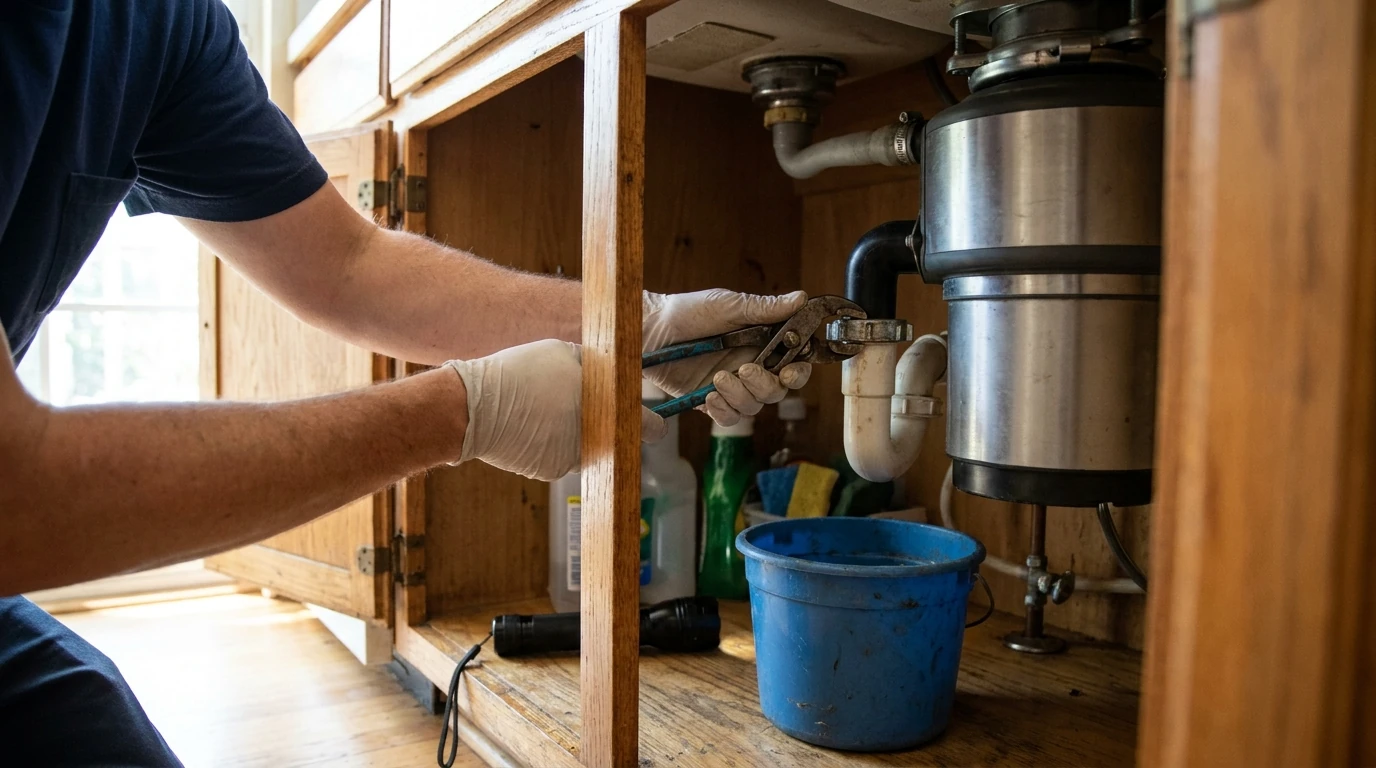
- Open the discharge pipe. If gentle plunging doesn’t clear it, place a bucket under the disposal’s plumbing. Loosen the slip nut on the discharge pipe (the pipe connecting the disposal to the trap) with Channellock pliers, then remove the flange with a screwdriver or wrench.
- Clean the pipe and discharge port. Clear any sludge from inside the discharge pipe, then shine the flashlight into the disposal’s discharge port and clear that too. Gloves and a mask are worth wearing here.
- Check the rubber gasket. Inspect the discharge gasket where the pipe meets the drain line. If it’s cracked or flattened, replace it. They are inexpensive, and hardware store staff can help you match the right one.
- Reassemble and test. Reposition the discharge pipe, refasten the flange, and hand-tighten the slip nut with the Channellock pliers. Don’t overtighten; a cracked slip nut leaks worse than the clog did. Plug the disposal back in and run water to confirm it drains clean.
What if the clog keeps coming back, or the disposal won’t spin at all?
A recurring clog or a disposal that hums but doesn’t turn usually points to a problem past the point a homeowner can safely reach. A jammed impeller, a worn motor bearing, or a clog seated in the branch drain line behind the wall are all common culprits, and none of them clear with a plunger alone.
If you’ve gone through every step above and the water still won’t drain, or the unit trips its reset button repeatedly, stop opening it up further. Repeated manual resets on a jammed motor can burn it out, and a clog seated past the P-trap often needs a drain snake or camera inspection to find. If you’re already comparing a quick chemical pour against calling someone, our chemical drain cleaners vs calling a plumber guide breaks down which actually works and which just masks the problem.
When should you call a plumber instead of continuing to DIY it?
Call a plumber when the disposal hums without spinning, the clog returns within days, or water backs up into a second fixture like the dishwasher. Those are signs the problem is mechanical or sits deeper in the drain line than a homeowner can reach with a plunger and pliers.
RT Olson Plumbing, Heating and Air Conditioning handles garbage disposal repair and replacement across Corona and the surrounding Inland Empire, from a quick impeller jam on an older unit to a full swap when the motor’s done. See the garbage disposal repair and installation page for what a service call typically involves.
A disposal clog that won’t quit after the steps above usually isn’t a disposal problem anymore, it’s a drain line problem, and that’s worth a second opinion before you take the plumbing apart further. Call RT Olson Plumbing, Heating and Air Conditioning at (951) 344-5596 to get it looked at.
About RT Olson Plumbing, Heating and Air Conditioning
RT Olson Plumbing, Heating and Air Conditioning has served Corona, CA and the surrounding Inland Empire since 2014, holding California contractor license #997337 (verify any contractor’s license at cslb.ca.gov). The company offers 24/7 service and holds a 4.9-star Google rating across more than 600 reviews. This guide first ran on RT Olson’s previous website and was updated for Corona homeowners in October 2026.