
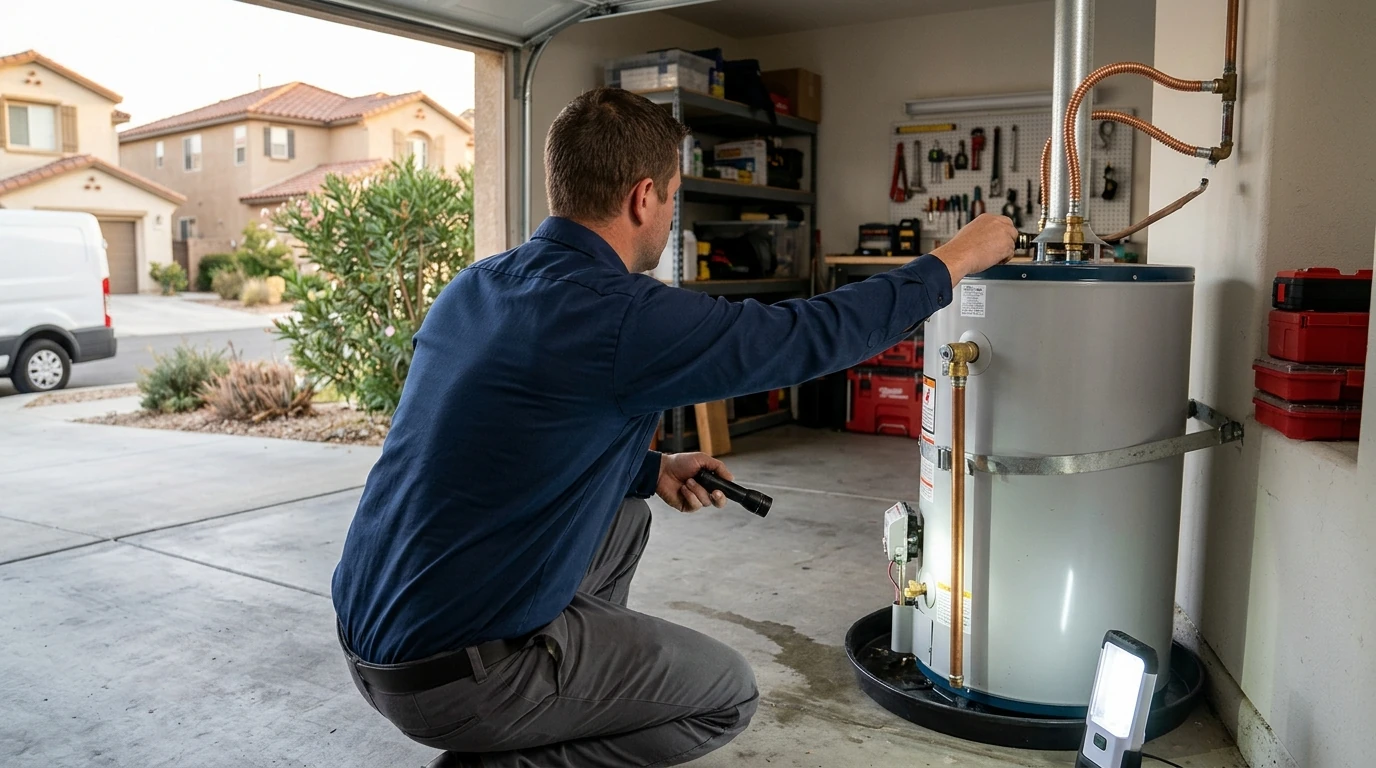
TL;DR: Most leaking water heaters in Corona are a same-day call, not a middle-of-the-night emergency, unless the leak is fast, you smell gas, or water is reaching drywall or carpet. Shut the cold water inlet valve on top of the tank clockwise, turn the gas control to “pilot” (or flip the breaker on an electric unit), then call a licensed plumber. RT Olson Plumbing, Heating and Air Conditioning answers around the clock at (951) 344-5596 if you need help closing it out.
If you just opened the garage door in Eagle Glen or South Corona and found a puddle spreading out from under the water heater, stop reading for ten seconds and go turn the cold water supply valve clockwise until it stops. That’s usually an oval handle or lever on the pipe entering the top of the tank. Once the water’s off, come back, because what you do next depends on exactly where that water is coming from. A loose fitting is a $150 fix. A corroded tank bottom means a new water heater, and knowing which one you’re looking at saves a wasted service call. Call (951) 344-5596 if you want a tech to help you sort out which one it is over the phone.
Is a leaking water heater an emergency?
A leaking water heater is an emergency only if the leak is fast and continuous, you smell gas near the unit, or the water is undermining flooring, drywall, or an attached room. A slow drip from a fitting or the drain valve can usually wait for a same-day appointment, not a 2 a.m. dispatch.
Corona’s water heaters work harder than average because of the Inland Empire’s hard water. Mineral buildup inside the tank corrodes the glass lining faster and strains the lower heating element or burner, so leaks often show up around year 8 to 10 rather than waiting for a full 12 to 15 year lifespan. That doesn’t make every leak urgent, it just means replacement is often already on the table once one shows up, something we break down in how long water heaters last and when to repair vs replace.
If you smell gas anywhere near the unit, treat it as a true emergency regardless of how the leak looks. Leave the house immediately, don’t flip light switches or anything else that could spark, and call 911 or SoCalGas’s emergency line from outside. Only after the utility confirms the gas is safe should you call a licensed plumber to repair the line or pressure test it. A plumber handles the repair after the gas company clears the scene, never instead of it.
How do you shut off the water, gas, or power to a leaking water heater right now?
Turn the cold water supply valve on top of the tank clockwise until it stops, then turn the gas control dial to “pilot” on a gas unit or switch off the dedicated breaker for an electric unit. That stops the leak from getting worse and keeps the heating element or burner from firing on a tank that’s losing water.
- Find the cold water inlet valve, an oval handle or ball valve on the pipe entering the top of the tank, and turn it clockwise until fully closed.
- On gas units, turn the gas control knob on the front of the tank to “pilot,” not fully off. That keeps the pilot lit without the main burner firing on a nearly empty tank.
- On electric units, go to the breaker panel and flip the dedicated water heater breaker, usually a double-pole 30-amp breaker, to off.
- If water is pooling near outlets or the panel, skip the breaker and call a plumber instead. Don’t wade into standing water near electrical equipment.
- Open a hot water tap somewhere in the house to relieve pressure in the lines, then grab towels or a shop vac for what’s already on the floor.
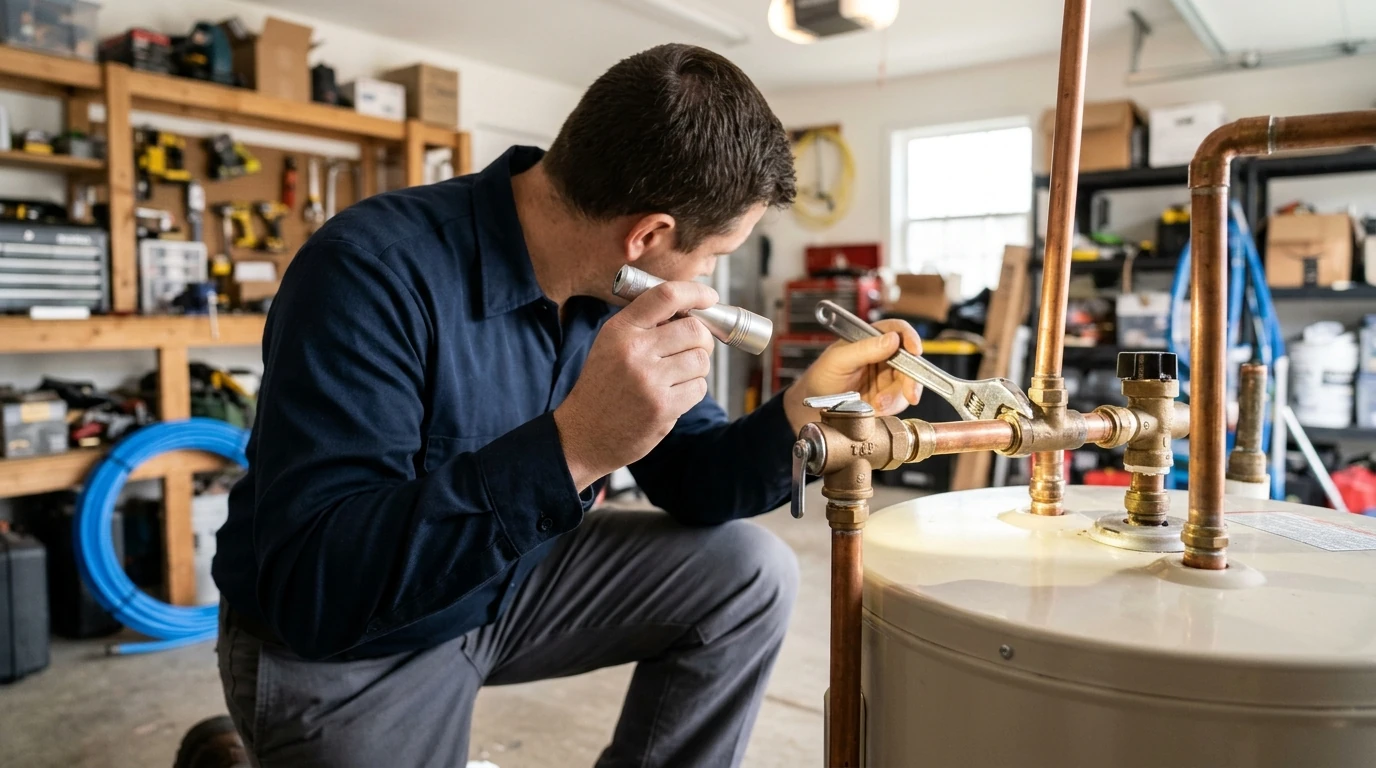
Where is the leak actually coming from?
Water heater leaks come from four places: the top fittings (supply lines or the cold water inlet), the temperature and pressure (T&P) relief valve, the drain valve near the bottom, or the tank itself through a corroded seam, and only the last one means the tank is done.
Top fittings are the easiest fix. A loose compression nut or a worn dielectric union usually just needs re-sealing or replacing, often under $200 in parts and labor. A dripping T&P valve is either a failed valve itself (common, and a straightforward swap) or a sign tank pressure is genuinely too high from a failed expansion tank or a closed-loop plumbing system, worth a proper diagnosis rather than just capping the valve. A leaking drain valve, the small spigot near the bottom used to flush the tank, is almost always a bad valve or loose cap, also a simple repair.
Water coming from underneath the tank itself, or rust-colored water pooling on the floor beneath the steel shell, means the inner tank has corroded through. There’s no patch for that. The tank gets replaced, not repaired, every time.
When does a leaking tank mean replacement instead of repair?
Replace, don’t repair, when the leak comes from the tank body itself, when the unit is past 8 to 10 years old in Corona’s hard water, or when a repair estimate runs close to half the cost of a new unit. A fitting or valve leak on a younger tank is usually worth repairing.
Check the serial number on the manufacturer’s rating plate. The first four digits are usually the manufacture date. A tank leaking at 9 or 10 years old with visible scale on the anode rod almost always makes more financial sense to replace than repair, since the next failure is close behind. We walk through tank and tankless options in water heater installation.
Who do you call: a plumber, the gas company, or a handyman?
Call a licensed plumber for any water heater leak that isn’t a suspected gas smell, call 911 or the gas utility first if you smell gas, and skip the handyman. Water heater work touches gas lines, pressure vessels, and code-required venting that fall outside general handyman work in California.
California requires a licensed contractor to legally install or repair a water heater (typically a C-36 plumbing license, sometimes C-4 for certain boiler and hot water heating work), and you can check any contractor’s license status with the CSLB before letting anyone touch a gas line. RT Olson Plumbing, Heating and Air Conditioning is licensed under California contractor license #997337 and answers 24/7 across Corona, Eagle Glen, Dos Lagos, and the rest of the Inland Empire. For a leak that’s turned into no hot water at all or active flooding, our emergency plumbing line gets a tech dispatched the same day, and our emergency plumber cost breakdown covers what that visit typically runs.
Shut the water off, note where the drip is actually coming from, and you’ve already done the hardest part. Schedule a water heater inspection or call (951) 344-5596 and a tech can tell you over the phone whether this is a $150 fitting or a same-day replacement.
About RT Olson Plumbing, Heating and Air Conditioning
RT Olson Plumbing, Heating and Air Conditioning has served Corona, CA and the surrounding Inland Empire since 2014, licensed under California contractor license #997337. The team handles water heater repair and replacement, emergency plumbing, drain and sewer work, and HVAC service across Corona, Riverside, Anaheim, and neighboring cities, and answers calls 24/7.