Air Duct Cleaning in Corona
Air duct cleaning in Corona and surrounding areas. Licensed and insured plumbing and HVAC pros, upfront pricing, free estimates. Call (951) 344-5596.
Air duct cleaning is one of the most oversold services in the HVAC industry, and that is exactly why it is worth doing honestly. There are real situations where cleaning the ductwork makes a measurable difference — a system with mold growing inside it, ducts a rodent has been living in, or a network so loaded with construction debris that it is pushing dust into every room. There are also plenty of homes where the ducts are clean, dry, and better left alone, and the money would do more good on filtration or air sealing. The value is in knowing which home you have before anyone runs a vacuum.
What air duct cleaning actually involves
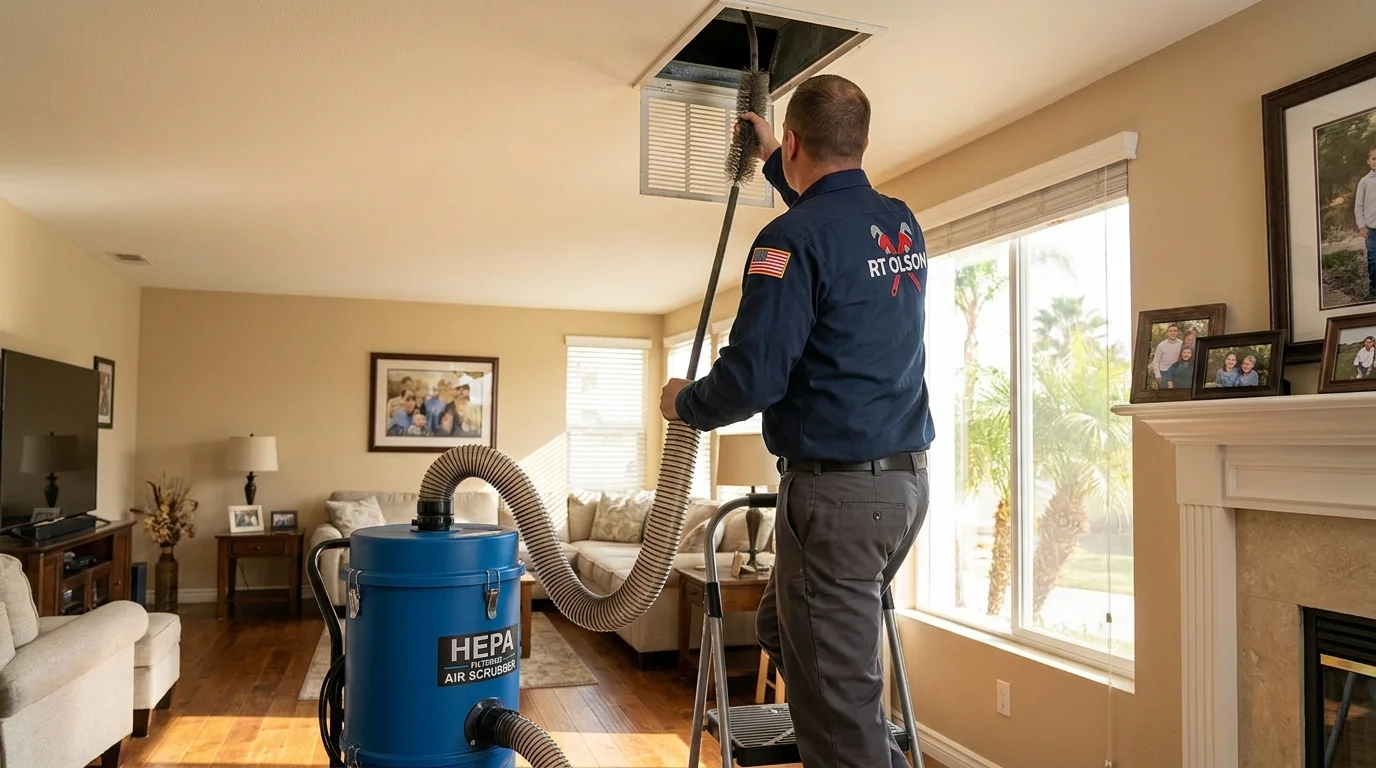
Real duct cleaning is a source removal process, not a quick pass with a shop vacuum at the registers. The distinction matters. Proper cleaning connects a powerful negative-air vacuum to the duct system so the entire network is under suction, then works through it section by section with brushes, air whips, or agitation tools that dislodge debris from the interior surfaces while the vacuum carries it away into a sealed collection unit outside the home. The goal is that everything loosened leaves the house rather than getting relocated or blown into the living space.
A complete job covers both the supply and return sides — many low-cost cleanings only touch the supplies and skip the returns, which is where a lot of the debris actually accumulates. It also includes the registers and grilles, the main trunk lines, and, where accessible, the blower compartment and evaporator coil area, which are common collection points for dust and biological growth. The blower and coil matter because a clean duct downstream of a fouled blower or coil reloads quickly.
What honest duct cleaning is not is a fix for a problem that lives somewhere else. If the ducts are dirty because they leak and pull attic debris into the return, or because the filter is undersized and letting particulate straight through, cleaning treats the symptom and the ducts reload. That is why the work starts with an inspection, not a vacuum.
Our process
-
Inspection first, honest recommendation second. We visually inspect the register openings, run a camera through accessible duct sections where warranted, and check the blower and coil area. If the ducts do not genuinely need cleaning, we will tell you — and point you toward the filtration or sealing fix that will actually help — rather than cleaning for the sake of it.
-
System containment and negative air. When cleaning is warranted, we put the duct system under negative pressure with a dedicated vacuum before disturbing anything, so debris is captured and removed rather than pushed into the home. Registers are sealed off section by section to keep the suction focused.
-
Source removal, supply and return. Working through the system, we agitate the interior surfaces with brushes and air tools to release accumulated debris while the vacuum removes it, covering both supply and return runs, the trunk lines, and the registers — not just the easy-to-reach supplies.
-
Registers, blower, and coil area. We clean the register covers and address the blower compartment and accessible coil area, the collection points that will reload a freshly cleaned duct if they are skipped.
-
Verification and honest next steps. We confirm the accessible sections are clean and, if the inspection turned up the real driver — duct leakage, a filtration gap, or a coil that needs attention — we lay out what will keep the ducts clean rather than leaving you to repeat the cleaning in a year.
What separates a good duct cleaning from a bad one
The most common failure is the “blow-and-go” cleaning, where a low-priced operator runs a vacuum at a few registers, blows compressed air through without containment, and calls it done. That relocates dust rather than removing it and can push contaminants deeper into the system. Real source removal keeps the whole network under continuous vacuum so what is loosened actually leaves the house.
The second is skipping the return side and the components. A cleaning that only addresses supply registers leaves the returns, the blower, and the coil area — often the dirtiest parts — untouched, and the system reloads the ducts within a season. A complete job follows the debris to where it actually collects.
The third, and the one that costs homeowners the most, is cleaning ducts that did not need it while ignoring the real problem. A musty smell or a dust complaint driven by duct leakage, a bypassing filter, or a fouled coil is not solved by cleaning the ducts. Good operators diagnose the source; the ones to avoid sell the cleaning first and never look for why the ducts got dirty.
What does air duct cleaning cost?
Cost varies with the size of the home, the number of supply and return runs, the level of contamination, and whether components like the blower or coil need attention. Most homeowners fall somewhere in the ranges below; these are typical market figures, not RT Olson Plumbing, Heating and Air Conditioning quotes.
| Scenario | Typical range |
|---|---|
| Standard whole-home duct cleaning (source removal) | $400 - $1,000 |
| Larger home or high duct count | $800 - $1,500 |
| Add-on blower and coil area cleaning | $100 - $300 |
| Rodent-contaminated duct removal and replacement | Quoted per scope |
Be skeptical of rock-bottom “$99 whole-home” offers — they almost always describe a blow-and-go that does not remove the debris, and they frequently become an upsell on arrival. An honest scope reflects the actual work of source removal.
Seasonal and regional considerations
Corona and the wider Inland Empire are dry and dusty, and the Santa Ana wind events that push through the region carry fine particulate that loads returns and filters faster than in coastal climates. That environment makes a properly sized, well-sealed filter the single most valuable defense — it keeps debris out of the ducts in the first place, which is far cheaper than cleaning them out later. When homeowners do have a genuine duct problem here, it is more often heavy dust loading from that dry-season particulate or a rodent issue than the mold-in-ducts problem common in humid climates, though water intrusion into a duct run can create it.
The practical takeaway for the region is that cleaning is best treated as a response to a demonstrated problem, not a calendar habit. Keep the filter matched to the system and changed on schedule, and the ducts largely take care of themselves.
Service area
RT Olson Plumbing, Heating and Air Conditioning is based in Corona and serves homeowners and property managers throughout the Inland Empire and western Riverside County, including Riverside, Norco, Eastvale, Chino, Jurupa Valley, and Yorba Linda. We handle duct cleaning as an honest, situational service — recommended when there is a real reason and declined when there is not.
If you have visible mold in the ducts, a rodent problem, a heavy debris load from a renovation, or dust and odors you cannot trace, call RT Olson Plumbing, Heating and Air Conditioning at (951) 344-5596 for an inspection. We will tell you whether cleaning is the right answer before recommending it. Licensed and insured, license #997337.
Services We Handle
- Clean Ducts Vents
- Cleaning
- Dryer Vent Cleaning
- Repair Ducts Vents
- Vent Cleaning
Frequently Asked Questions
Does air duct cleaning actually improve indoor air quality?
How do I know if my ducts genuinely need cleaning?
What is the source removal method and why does it matter?
Will duct cleaning fix my dust or allergy problem?
How often should ducts be cleaned?
Looking for the best air duct cleaning company in Corona?
RT Olson Plumbing, Heating and Air Conditioning provides licensed and insured air duct cleaning in Corona, CA and the surrounding area, and has served local property owners since 2014. Customers rate us 4.9 out of 5 stars across 619 Google reviews. We answer calls 24/7 — call (951) 344-5596 for immediate help.
Need Air Duct Cleaning now?
We respond 24/7 across Corona and surrounding CA cities.