
Leak Detection in Canyon Lake
Trusted leak detection in Canyon Lake, CA. Licensed and insured plumbing and HVAC pros, upfront pricing. Call (951) 344-5596.
Our technicians are dispatched from our Corona, CA headquarters and are typically on-site in Canyon Lake within 60 minutes of your call.
Canyon Lake’s position in the Inland Valley, surrounded by water on three sides and built largely on decomposed granite and clay-heavy soils, creates plumbing conditions that don’t behave the way most homeowners expect. The lake itself keeps ambient humidity higher than nearby Corona or Murrieta, and the soil’s tendency to shift seasonally puts lateral supply lines and slab penetrations under stress year-round. If your water bill has crept up without explanation, or you’ve noticed a soft spot in your flooring or a persistent damp smell near a wall, there’s a good chance a hidden leak is already doing damage below the surface.
Why Canyon Lake Properties See Leak Detection Issues
Most of Canyon Lake’s residential stock was built between the late 1960s and the early 1990s, when copper and galvanized steel were the standard pipe materials. Copper holds up well in dry climates, but the combination of hard water from the regional water system and the slight ground movement common to this area accelerates pinhole corrosion at fittings and elbows. Galvanized pipe in older homes has frequently reached or exceeded its service life, making hairline failures at joints especially common.
Slab foundations, the dominant construction type throughout Canyon Lake, make leaks particularly deceptive. Water migrating under a concrete slab can travel several feet from the actual breach before it surfaces, which means the warm spot you feel underfoot near the hallway may have nothing to do with the pipe directly beneath it. Electronic leak detection equipment is the only reliable way to trace the source without unnecessary concrete removal.
The gated community structure of Canyon Lake also means that irrigation systems and shared utility corridors are more common here than in unincorporated Riverside County neighborhoods nearby. Underground supply lines serving these systems are exposed to the same soil movement as residential lines, and because they run longer distances, even a slow drip can waste thousands of gallons before anyone notices.
Our Leak Detection Process in Canyon Lake
When we arrive at a Canyon Lake property, the first step is pressure testing the system to confirm a leak is present and to estimate its severity. We isolate sections of the supply line to narrow the location before any equipment touches the slab or yard.
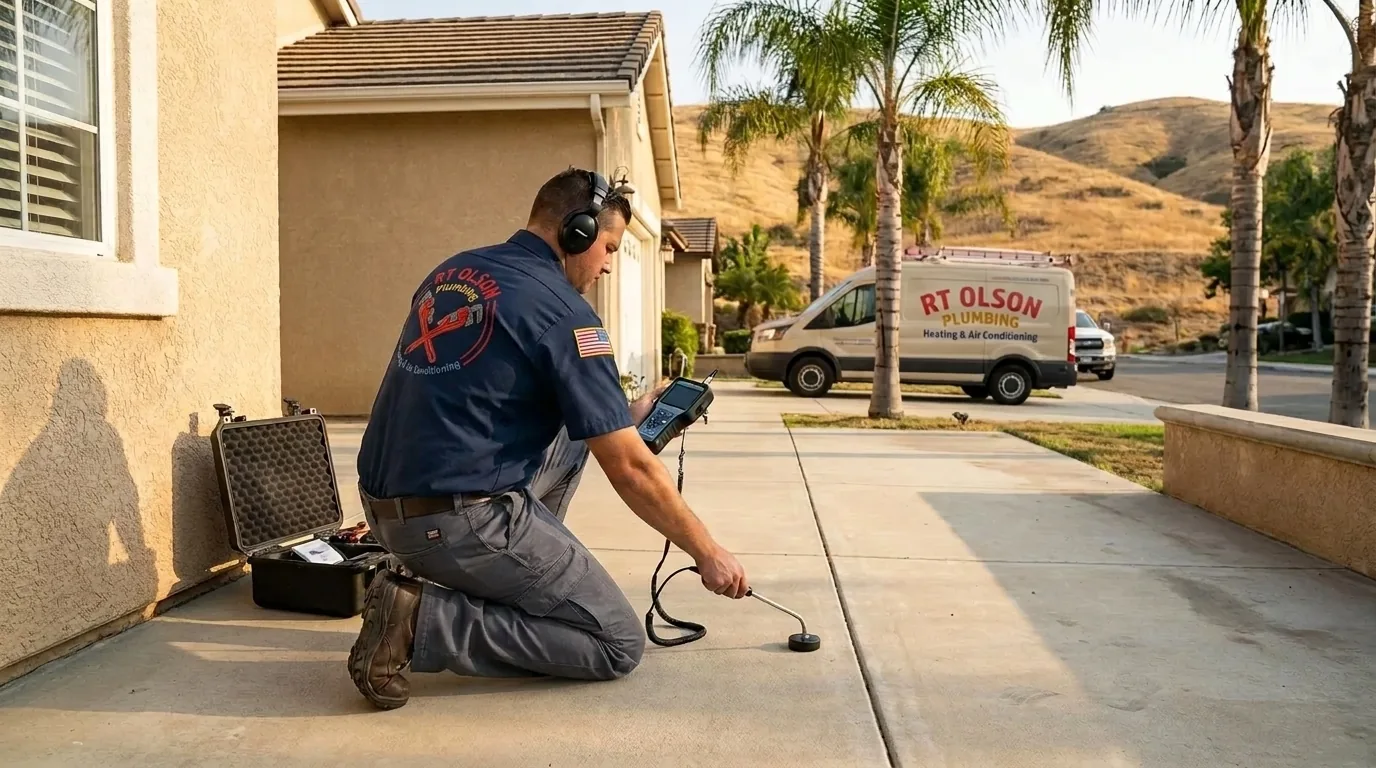
From there, we use electronic acoustic listening devices to detect the frequency signature of water escaping under pressure. In slab construction, which is nearly universal in Canyon Lake, this method lets us pinpoint a leak to within inches without opening the floor. For underground irrigation or service line leaks in the yard, we pair acoustic detection with ground-penetrating correlation when the signal is ambiguous.
Thermal imaging is a useful secondary tool on interior walls, especially in homes where the original copper lines run through interior partitions. A slow drip behind drywall won’t always show moisture at the surface, but the temperature differential it creates is visible on a thermal camera.
Once the source is confirmed, we document the location precisely, depth, pipe type, and breach characteristics, so that repair decisions are based on facts rather than guesswork. We can discuss repair options on-site and, if excavation or slab work is needed, walk you through what that scope looks like before anything is opened.
Reaching Canyon Lake from Corona
Our team dispatches from Corona, and Canyon Lake is a regular service area for us. The most direct route runs south on the 15 freeway to Railroad Canyon Road, which feeds directly into the Canyon Lake community. Because Canyon Lake is a gated private community, we coordinate entry with the property owner before dispatch so there’s no delay at the gate, something that matters when a slab leak is actively running. We’re available around the clock, so if you’re hearing water running inside a wall at midnight, calling (951) 344-5596 gets you a live response, not a voicemail.
Local Note
Canyon Lake’s HOA governs not just aesthetics but also access to utility easements and the timing of exterior work. If a leak detection job requires accessing a shared utility corridor or breaking ground anywhere near the lake-adjacent parcels, the HOA may require advance notification or a permit from the community’s facilities office before work begins. We’ve worked in gated HOA communities throughout Riverside County and know to ask about those requirements at the first call, not after we’ve already mobilized. It saves everyone a wasted trip and keeps the job on schedule.
Closing
A hidden leak in a Canyon Lake home doesn’t wait for a convenient time to get worse. The combination of aging copper supply lines, slab construction, and the soil conditions specific to this part of Riverside County means that what starts as a high water bill can become a damaged subfloor or a compromised foundation if it goes unaddressed. Call RT Olson Plumbing, Heating and Air Conditioning at (951) 344-5596, we’ll locate the source accurately, explain your options clearly, and get your Canyon Lake home back to dry ground.
Serving Canyon Lake from our Corona headquarters — ★ 4.9 · 619 Google reviews
“These guys were on time and they did quality work.” — Bob, October 2026Read our reviews on Google →
Leak Detection in Canyon Lake: Service Coverage
Frequently Asked Questions
How fast can you arrive for leak detection in Canyon Lake?
Can you access the Canyon Lake gated community for an emergency leak detection call?
Does Canyon Lake's HOA have any rules that affect leak detection or repair work on my property?
My water bill spiked but I don't see any wet spots, is that common in Canyon Lake homes?
How does the hard water in Canyon Lake's regional water system affect copper pipes over time?
What does electronic leak detection actually involve, and how long does it take for a typical Canyon Lake home?
Will my homeowners insurance cover leak detection in Canyon Lake?
Leak Detection response in Canyon Lake
Most Canyon Lake calls see a technician on-site within 60 minutes from our Corona headquarters.