
Leak Detection in Rialto
Trusted leak detection in Rialto, CA. Licensed and insured plumbing and HVAC pros, upfront pricing. Call (951) 344-5596.
Our technicians are dispatched from our Corona, CA headquarters and are typically on-site in Rialto within 60 minutes of your call.
Rialto sits in the heart of the Inland Empire, where summer temperatures regularly push past 100°F and the soil, a mix of alluvial sand and clay deposited by the Santa Ana River over centuries, expands and contracts with every wet and dry season. That ground movement puts constant stress on water supply lines and slab foundations, and it’s one of the main reasons homeowners here often notice a mysteriously climbing water bill long before they ever spot a wet spot on the floor. When a hidden leak is somewhere beneath a concrete slab or behind a stucco wall, finding it fast matters, both for your water bill and for the structural integrity of your home.
Why Rialto Properties See Leak Detection Issues
The Inland Empire’s climate is hard on plumbing in ways that aren’t always obvious. Rialto experiences wide temperature swings between summer highs and winter nights that can dip near freezing, enough to stress pipe joints and accelerate micro-cracking in older copper and galvanized lines. Much of Rialto’s residential housing stock was built during the postwar and 1960s–1980s tract-home booms, when copper supply lines were standard. Copper is durable, but after 40 or 50 years in reactive soil, pinhole leaks are a predictable outcome rather than a surprise.
Slab construction is nearly universal in this part of San Bernardino County. That means when a supply line or drain line develops a leak, the water has nowhere to go but laterally through the slab or upward through flooring, often staying invisible until the damage is already significant. A warm patch on a tile floor, a faint sulfur or musty odor near a baseboard, or a water meter that keeps spinning after every fixture is shut off are the early signals worth taking seriously.
Our Leak Detection Process in Rialto
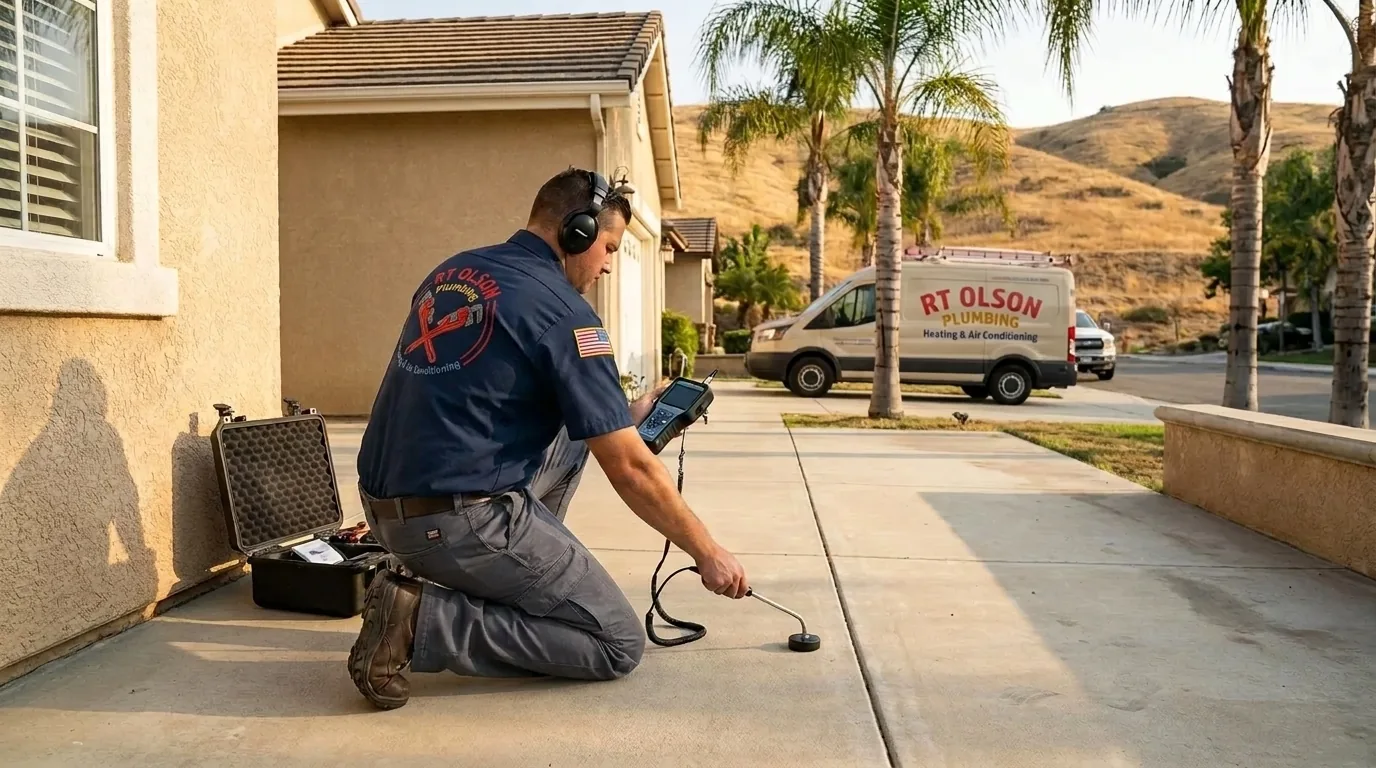
Because most Rialto homes are slab-on-grade, the detection process has to be non-invasive first. Cutting into a slab without confirming the leak location is expensive and disruptive, a mistake that costs more to fix than the leak itself. The approach here starts with a pressure test on the supply side to confirm a leak is present and isolate which line is losing pressure. From there, electronic amplification equipment picks up the acoustic signature of water escaping under pressure, a faint hissing or rushing sound that travels through concrete and is inaudible to the human ear without the right tools.
Thermal imaging adds a second layer of confirmation. A pressurized leak changes the temperature profile of the slab above it, and an infrared camera makes that temperature gradient visible. Combining acoustic detection with thermal imaging narrows the location to within inches before any concrete is touched. That precision matters especially in Rialto, where slab thickness and aggregate composition can vary between neighborhoods built in different decades, older slabs sometimes transmit sound differently than poured concrete from the 1990s onward.
Reaching Rialto from Corona
RT Olson’s team dispatches from Corona around the clock, 24/7, including weekends and holidays. The most direct route to Rialto runs east on the 91 Freeway to the 15 North, then east on the 210 or surface streets depending on where in the city the call originates. Western Rialto, closer to Fontana, is typically accessible via Riverside Avenue or Ayala Drive off the 210. Eastern Rialto near the San Bernardino border is a short run from the 215. Because the Inland Empire freeway system connects these corridors reliably, the team can reach most Rialto addresses at any hour without the surface-street congestion that slows response during peak commute windows.
Local Note
One pattern worth knowing in Rialto: homes built in the 1970s and early 1980s in the tracts south of Baseline Road frequently used polybutylene pipe for interior distribution lines, a material that was phased out nationally after widespread failure claims in the 1990s. If your home was built during that window and you haven’t had the plumbing evaluated, a sudden unexplained pressure drop or a recurring damp spot near an interior wall may point to polybutylene fatigue rather than a simple joint failure. Leak detection in these homes sometimes reveals that a single confirmed leak is the first sign of a system-wide issue worth addressing proactively.
Equipment & Methods We Use for Leak Detection
The core toolkit for slab and underground leak detection includes electronic ground microphones, acoustic correlators, and thermal imaging cameras. For suspected underground line leaks, irrigation laterals, main service lines running from the meter to the house, tracer gas detection is an option when acoustic methods produce ambiguous results. Tracer gas (a safe, inert hydrogen-nitrogen mixture) is introduced into the line and detected at the surface with a sensitive probe; it escapes through the smallest breach and rises through soil, pinpointing the leak without excavation.
For suspected drain line leaks, a sewer camera inspection runs alongside the acoustic work, drain lines in Rialto’s older housing stock are often cast iron or Orangeburg, both of which degrade in ways that acoustic detection alone won’t fully characterize.
If your water meter is running when everything in the house is off, or if your bill from Rialto’s water utility has spiked without an obvious explanation, call RT Olson at (951) 344-5596. The sooner a hidden leak is located, the less concrete, flooring, and drywall ends up in a dumpster.
Serving Rialto from our Corona headquarters — ★ 4.9 · 619 Google reviews
“Great service, on time with great communication.” — Rodney, October 2026Read our reviews on Google →
Leak Detection in Rialto: Service Coverage
Frequently Asked Questions
How fast can you arrive for leak detection in Rialto?
My Rialto water bill jumped significantly but I can't find any wet spots, what should I do first?
Are homes in Rialto built in the 1970s and 1980s more likely to need slab leak detection?
How does Rialto's soil affect underground water line leaks?
Do you use non-invasive methods before cutting into a slab in Rialto?
Can you respond to a leak detection call in Rialto at night or on weekends?
Will my homeowners insurance cover leak detection in Rialto?
Leak Detection response in Rialto
Most Rialto calls see a technician on-site within 60 minutes from our Corona headquarters.