
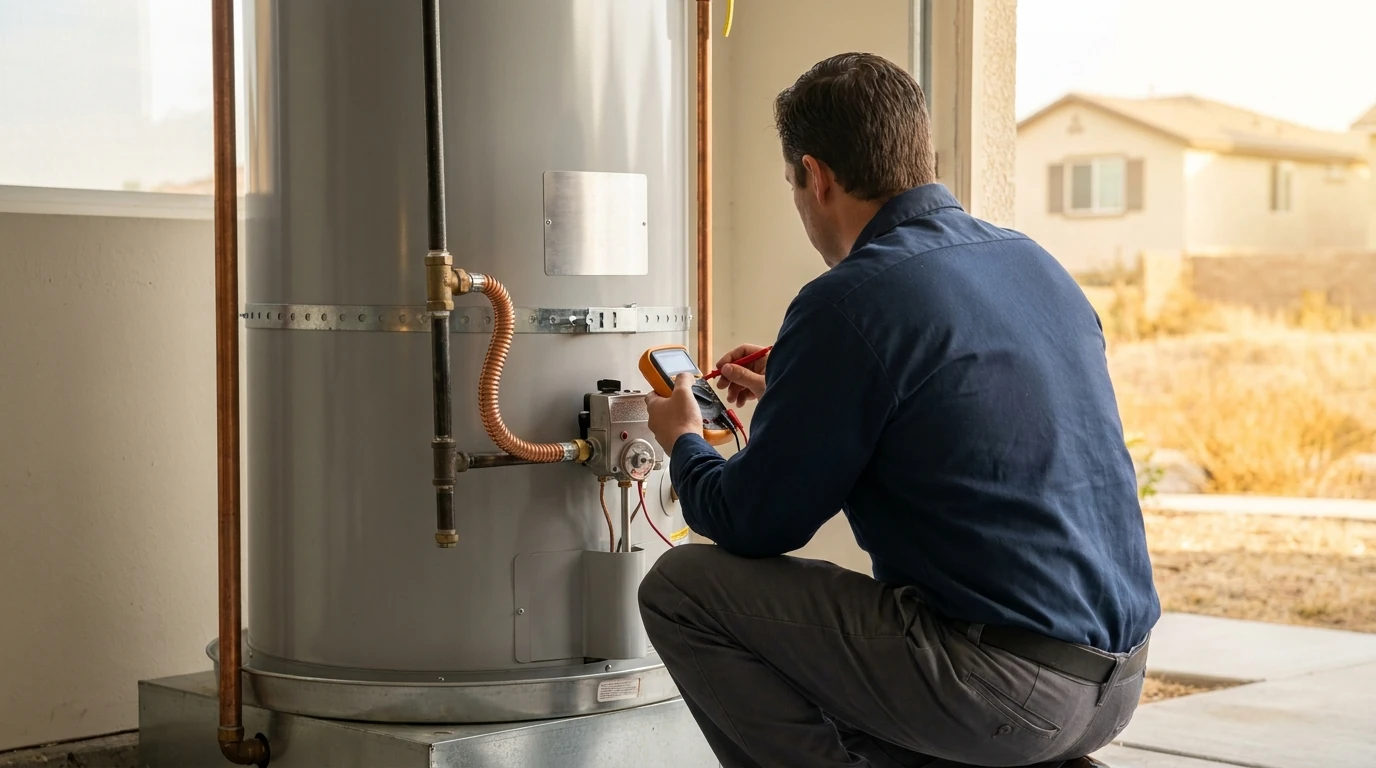
TL;DR: A water heater repair in Corona typically costs $150 to $600 depending on the part (thermocouple, heating element, gas valve). A full tank replacement runs $1,500 to $3,500 installed; a tankless conversion runs $3,500 to $6,500 because of the gas line and venting work. Corona’s hard water shortens tank life to roughly 8-10 years instead of the 12+ years a softened-water home might see, so anode rod condition and sediment buildup matter more here than in most markets.
If you’re standing in a cold shower in Eagle Glen or Dos Lagos right now, or you just got a quote that felt steep, you’re probably trying to figure out whether this is a $200 fix or a $3,000 one. The honest answer depends on the unit’s age, what’s actually broken, and whether the tank itself has started to corrode. Here’s how to tell the difference before you spend a dollar.
How much does a water heater cost in Corona, CA?
Most water heater repairs in Corona cost between $150 and $600, while full replacement runs $1,500 to $6,500 depending on whether you stay with a tank or switch to tankless.
Small parts like a thermocouple, igniter, or heating element run on the lower end, usually $150 to $350 installed. A failed gas control valve or a leaking T&P (temperature and pressure relief) valve lands closer to $300 to $600. Any time a technician quotes a repair, ask what’s included in writing: parts, labor, and whether a permit is pulled if the gas line or venting is touched.
Replacement pricing splits two ways. A standard 40-50 gallon tank unit, installed with new flex connectors, a drip pan, and seismic strapping (required in California per CPC Section 507.2), typically runs $1,500 to $3,500. A tankless conversion costs more upfront, $3,500 to $6,500, because most Corona homes need a gas line upsize and new concentric venting to hit the unit’s BTU demand. Request a water heater quote in writing before committing either way.
Tank or tankless: which one actually fits your home?
A tank water heater fits most Corona homes better on upfront cost; a tankless unit fits better for households that run out of hot water or want 15-20 years of service life instead of 8-12.
Tank units store 40-50 gallons and are simpler to repair, since most failures are a single part. Tankless units heat water on demand and never run out, but they need a dedicated gas line sized for the unit and a Energy Star certified model to qualify for utility rebates. We cover this trade-off in detail in our tankless vs tank comparison, including sizing by fixture count.
One factor specific to this area: Corona’s water hardness accelerates mineral scale inside tankless heat exchangers faster than in softer-water markets, so a tankless install here should come with a recommendation for annual descaling or a point-of-use filter, not just a one-time flush.
What are the signs your water heater actually needs attention?
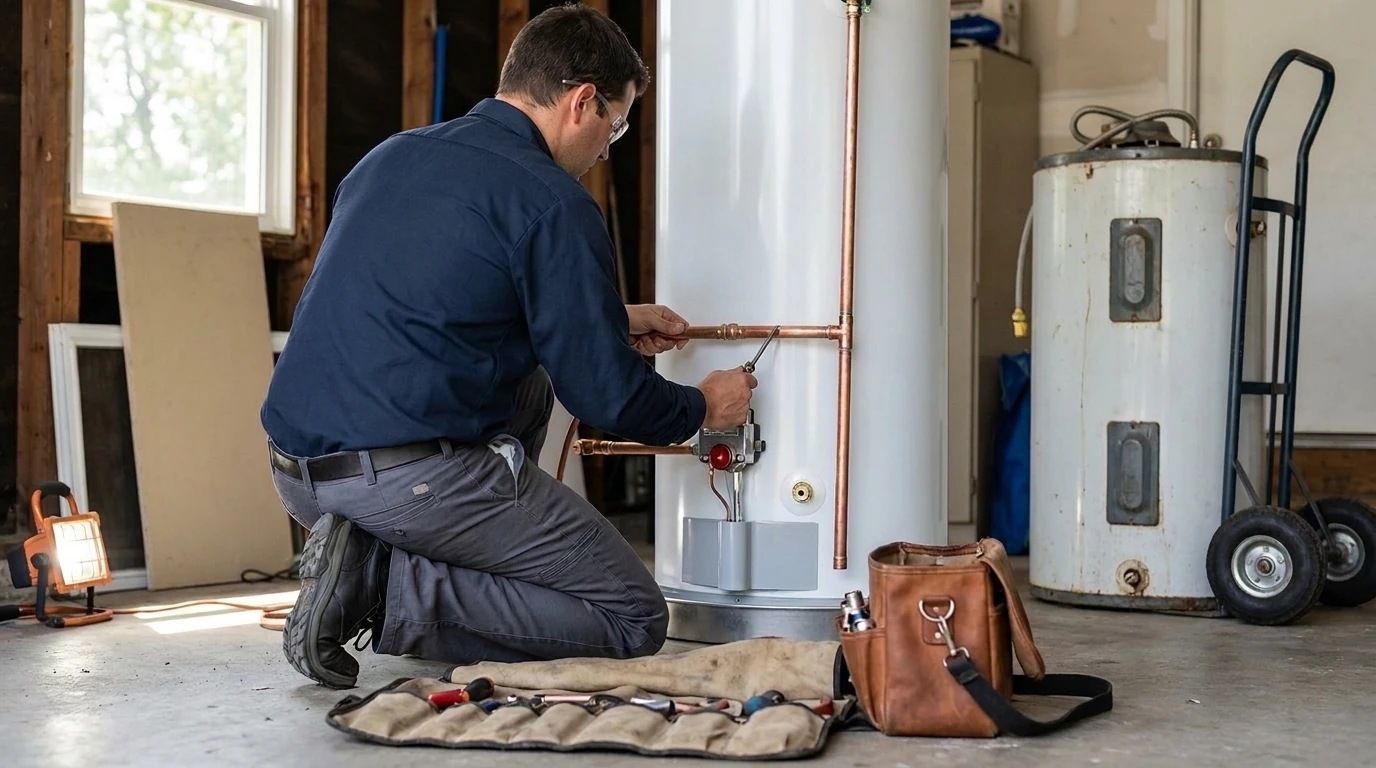
Rumbling or popping sounds, rusty water at the tap, or a pool of water at the base of the tank are the three signs that mean call someone now, not next month.
Rumbling usually means sediment has built up on the tank floor and is boiling underneath it, which both wastes energy and stresses the tank seams. Rusty hot water (cold water running clear) points to internal tank corrosion, typically after the anode rod has fully dissolved. Water pooling at the base can be condensation, a loose fitting, or an actual tank breach, and only one of those three is a quick fix. We walk through the sound-specific diagnosis in why your water heater is making noise, and if the unit is near the end of its expected service window, our repair-or-replace guide has the full decision tree.
If you’re not sure how old the unit is, the serial number on the manufacturer data plate encodes the manufacture date; most techs can read it on the spot during an inspection.
Why do water heaters fail faster in Corona than in other markets?
Hard water accelerates sediment buildup and anode rod consumption, which is why a tank water heater in Corona often needs attention by year 8 instead of year 12.
Corona’s municipal supply runs higher in dissolved minerals than coastal Orange County systems, and that mineral load settles as sediment inside the tank and scales onto the heating element or gas burner surface. The EPA’s WaterSense program and ENERGY STAR both note that mineral buildup is one of the most common drivers of reduced water heater efficiency and premature failure, independent of brand or install quality. A whole-house water softener extends tank life meaningfully in neighborhoods like Eagle Glen and Dos Lagos, where many homes still run original 1990s-2000s plumbing alongside newer fixtures.
California also requires seismic strapping on every water heater (CPC 507.2) and a properly routed T&P discharge line to within 6 inches of the floor or to an approved drain. These aren’t optional add-ons. A quote that skips them is a quote that will need correcting at resale inspection.
What should you do next?
If the unit is leaking from the tank itself, is past 10 years old, or is showing rust in the hot water, get a same-week inspection rather than waiting for a full failure on a weekend.
A 15-minute inspection confirms whether you’re looking at a $200 part or a full swap, and gives you a written quote with the permit and strapping included before any work starts. Call RT Olson Plumbing, Heating and Air Conditioning at (951) 344-5596 to schedule a water heater inspection, or request a written installation quote if you already know you’re replacing.
RT Olson has handled water heater repairs and installs across Corona and the surrounding Inland Empire since 2014, so this isn’t guesswork, it’s a pattern we see on a weekly basis in this exact water chemistry.
About RT Olson Plumbing, Heating and Air Conditioning
RT Olson Plumbing, Heating and Air Conditioning is a licensed plumbing and HVAC contractor based in Corona, CA (CSLB License #997337), serving the Inland Empire and surrounding Orange County communities since 2014. The company offers 24/7 emergency service and holds a 4.9 Google rating across 615 reviews. Their technicians handle water heater repair and installation, drain and sewer work, leak detection, and heating and air conditioning service throughout the region.