
Whole-House Repiping in Corona
Whole-house repiping in Corona and surrounding areas. Copper and PEX repipes by licensed plumbing pros, upfront pricing, free estimates. Call (951) 344-5596.
When the water pressure in your shower drops to a trickle while someone runs the kitchen tap, or when rust-colored water stains your fixtures every morning, the problem usually isn’t a single bad fitting, it’s the pipe system itself. Homes built with galvanized steel, polybutylene, or early CPVC often reach a point where patching one section just shifts the failure to the next. A whole-house repipe replaces every supply line from the meter to the fixtures in a single coordinated project, restoring full pressure and clean water throughout the home.
What whole-house repiping actually involves
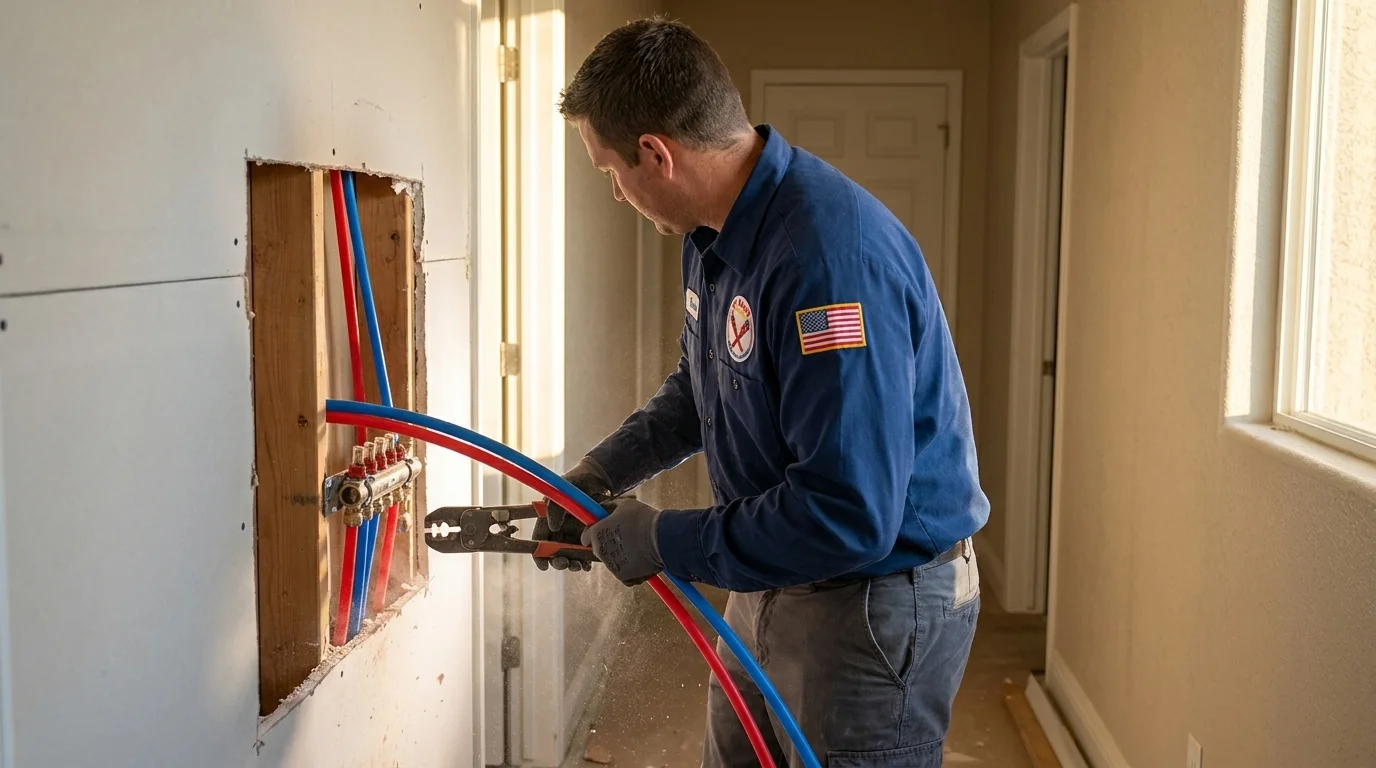
A repipe isn’t a repair, it’s a systematic replacement of every hot and cold supply line running through your walls, floors, and ceilings. Depending on your home’s layout and the material chosen, a crew will open walls or ceilings at strategic access points, pull the old pipe, and run new lines before patching and painting.
The two dominant materials today are copper and PEX (cross-linked polyethylene). Copper is rigid, long-proven, and preferred in some municipal inspections; PEX is flexible, faster to route through existing framing, and more resistant to the kind of minor seismic movement common throughout Southern California. In Corona and the Inland Empire, where homes range from mid-century tract construction to newer master-planned builds, the right choice depends on your water chemistry, your home’s layout, and your long-term plans.
For a typical single-family home, three bedrooms, two baths, 1,400 to 2,000 square feet, the physical work usually spans two to three days. Water is off only during active installation; crews restore service at the end of each working day whenever the project allows. Drywall patching and finish painting are either included in the scope or scheduled as a separate follow-on phase.
Our process
-
Pipe assessment and material selection. Before any wall is opened, we trace your existing supply lines, identify the pipe material and condition, document fixture count and water pressure at multiple points, and confirm which material, copper or PEX, suits your home’s specific layout and water conditions.
-
Permit and inspection coordination. In Corona and surrounding Riverside County cities, supply-line replacement requires a permit and a rough-in inspection before walls close. We pull the permit, schedule the inspection, and keep the project on the inspector’s calendar so there’s no delay between rough-in and close-up.
-
Systematic pipe removal and new-line installation. Access points are cut at calculated locations to minimize drywall damage. Old pipe is removed in full runs, not capped and abandoned, and new lines are routed, supported at code-required intervals, and connected to fixtures and the main shutoff.
-
Pressure test and inspection sign-off. Before any wall closes, the new system is pressure-tested and the rough-in inspection is completed. This is the step that separates a properly documented repipe from one that creates problems at resale.
-
Wall restoration and final walkthrough. Access points are patched, textured to match, and painted. We walk every fixture with you, faucets, shower valves, hose bibbs, the icemaker line, confirm pressure and flow, and hand you the permit card and inspection record for your files.
What separates a good repipe from a bad one
The most common shortcut in whole-house repiping is selective replacement, swapping only the visible or accessible runs while leaving deteriorated pipe inside walls. When that remaining pipe fails two years later, the homeowner assumes the repipe failed. It didn’t; it was never complete.
A second common problem is skipping the permit. An unpermitted repipe won’t show a rough-in inspection on record, which surfaces during a home sale and can require the buyer’s lender to demand a re-inspection or a price adjustment. Pulling the permit costs time upfront and saves significant money and stress at closing.
On PEX installations specifically, improper support spacing and failing to use the correct fittings for your local water chemistry are the two issues that generate callbacks. Inland Empire water is hard, high mineral content that can interact with certain fitting materials over time. Specifying the right fitting type for this region isn’t optional.
What does whole-house repiping cost?
Typical costs for a whole-house repipe vary with home size, pipe material, fixture count, and how much of the wall restoration is included in the scope. Most homeowners pay somewhere in the ranges below, these are industry-typical figures, not a quote from RT Olson.
| Scenario | Typical range |
|---|---|
| Small home (2 bed/1 bath), PEX | $4,000 – $7,000 |
| Mid-size home (3 bed/2 bath), PEX | $7,000 – $12,000 |
| Mid-size home (3 bed/2 bath), copper | $9,000 – $15,000 |
| Larger home (4+ bed, 3+ bath), PEX | $12,000 – $20,000 |
| Polybutylene or galvanized full replacement, any size | Add $1,500 – $3,500 for additional access and disposal |
| Drywall patching and paint (if separate scope) | $1,500 – $4,000 depending on access-point count |
Every home is different, and RT Olson provides a written scope of work with line-item pricing before any work begins. As for insurance: standard homeowners policies generally do not cover elective repiping, but if deteriorated pipe has caused water damage, a slow leak behind a wall, for example, the resulting damage may be a covered loss even when the pipe replacement itself is not. We document pipe condition thoroughly so you have what you need for that conversation with your carrier.
Seasonal and regional considerations
Corona sits in a climate zone where hard freezes are rare but not unheard of, exposed hose bibbs and garage-routed supply lines can freeze during sharp January cold snaps. If your current galvanized or polybutylene system has already been patched at a freeze point, that’s a useful data point when planning pipe routing during a repipe. We route new lines away from uninsulated exterior walls wherever the framing allows.
Hard water is the bigger long-term factor in this region. Galvanized pipe in Inland Empire homes often shows accelerated interior scaling compared to coastal installations, which is part of why pressure loss in older Corona homes can be dramatic even before the pipe shows external corrosion.
Service area
RT Olson Plumbing, Heating and Air Conditioning is based in Corona and serves homeowners and property managers throughout the surrounding Inland Empire and foothill communities, including Norco, Eastvale, Riverside, Chino Hills, Ontario, Rancho Cucamonga, and Yorba Linda. The city-specific pages for each area link back here for the full technical detail on how a repipe works.
If your water pressure has been declining, your fixtures are staining, or a plumber has told you the pipe itself is the problem, call (951) 344-5596 to schedule a whole-house pipe assessment, and get a written scope before you commit to anything.
Services We Handle
- Re Pipe with Pex or Copper Pipe
- Repipe Your Home with Copper Pipe
- Repipe Your Home's Water Lines with PEX
- Repiping Your Home
- Whole-house Repiping
Frequently Asked Questions
Does homeowners insurance cover whole-house repiping?
How do I know whether I need a full repipe or just a section replaced?
What is polybutylene pipe and why does it need to be replaced?
How long does a whole-house repipe take, and will we be without water the entire time?
Copper versus PEX, which is better for a Corona home?
Looking for the best repiping company in Corona?
RT Olson Plumbing, Heating and Air Conditioning provides licensed and insured repiping in Corona, CA and the surrounding area, and has served local property owners since 2014. Customers rate us 4.9 out of 5 stars across 612 Google reviews. We answer calls 24/7 — call (951) 344-5596 for immediate help.
Need Repiping now?
We respond 24/7 across Corona and surrounding CA cities.
Related Coverage
- Our Plumbing Services, Plus Heating & Air
- Contact RT Olson Plumbing, Heating and Air Conditioning
- Leak Detection in Corona
- Water Heater Installation and Replacement in Corona
- 24/7 Emergency Plumbing in Corona
- 7 Warning Signs of a Slab Leak (and What To Do About Them)
- Low Water Pressure in Your House? Here Are the Usual Suspects